Tietoviikko magazine listed 25 most interesting startups from Finland (February 2010). The list is put together by acknowledged experts from Forum Virium Helsinki, Technopolis and Arctic Startup. All of these corporations should have very good picture of the overall situation.
Finland has not exactly been the cradle of startups and entrepreneurship hasn't been that desirable alternative due to non-existing support systems, heavy bureaucracy and public image. Nowadays it is ok --or even cool and fun-- to be an entrepreneur!
Within the last few years there has been several good efforts to spur startups and "facelift" entrepreneurship in Finland. Few years back National technical research center VTT set up a division to spur research driven innovations and spin offs. Startup companies network e.g. at Open Coffee type of events and university students in Helsinki have set up Aalto Entrepreneur Society (AES). AES is one prime example of the new mindset. Traditionally Finns have been far from brilliant in pitching or even presenting things. I have heard many legends from the 1980s how Finns did things in their own way abroad. Maybe that is part of Finnish way of being -- it is good to be humble and make sure not to push your own persona or ideas too much. Otherwise you are annoying, too Swedish or American or just trying to be better than the rest. Lately the common understanding has been that if you want to make a difference, run a profitable company and make good exit you need to do networking and improve your sales skills. I personally am really thrilled to see things evolving. That's why I was surprised by the Tietoviikko list.
At first it struck me that this lists is (at least between the lines) suggesting that not that much is actually happening in Finland. 8 out of 25 most interesting companies were founded in 2005 or earlier. Naturally it takes sometime to make magic happen but is this really the case? Is a company doing RFID solutions for industrial logistics (founded in 2002) more interesting than any other more recent startups? Don't get me wrong. I have nothing against this or any other company on the list and I know it takes some time for businesses to evolve. I am just wondering how long do we expect the next big thing to come from these companies? Aren't there really any challengers? The other interesting thing is the fact that the list contains several consulting companies or companies offering services. Again nothing wrong with that but sounds rather local to me.
There were also some surprises on the list. One is Grey Area. I was involved in Nordic Game Program jury when Grey Area got small fund to develop their location based mobile game further. I personally believe that there are certain niches in location based gaming (e.g. exergaming) which will make good business as soon as people have GPS phones and flat fare data transmission deals. As a basic concept location based gaming is not new and it is relatively hard to monetize. Of course I might be wrong :) Still I wonder if I got the message right: do the experts believe that LBS gaming will be bigger than social gaming (when looking at Finnish startups and their potential to pull it through)?
Oh - and at least one of the companies - Vilant Systems - was also listed as one of the key growth companies (Kauppalehti Dec 2009). Certainly the criteria and focus of these lists is different but still interesting. The discussion continues at the Tietoviikko web site (in Finnish only).
All I can say is MORE IT STARTUPS TO FINLAND PLEASE :)
Showing posts with label digital media. Show all posts
Showing posts with label digital media. Show all posts
Monday, February 08, 2010


Thursday, January 14, 2010
Addition to my "closing of 2009" post
A couple of things: first of all thanks to the feedback to my previous blog post! I just wanted to add that yes, I am also working with good guys at Paf and we are about to revolutionize online money gaming. Unfortunately I (and we ) didn't have enough time to do it last year ;) But I can assure you that it will most definitely happen this year!
So yeah yeah! I am also spending a lot of time with online gaming, social media and iGaming (= online money games). There hasn't been that many innovations in years. Online slot machines and lottery games are surprisingly similar what they were already hundreds of years ago. But wait no more. The change is coming.
Besides writing about 2010 trends, I also follow how other people and companies see the coming year. Atm one of my favorite post is by Osma Ahvenlampi (CTO of Sulake, and Scrum guru). His viewpoint (blog post: "Technology factors to watch during 2010") is purely technical but good stuff! I especially liked "Browsers vs desktops: what's the target for entertainment software?" discussion. See picture. Read more from the blog.

He also have a good point that: "the history of the “computer revolution” has been about automation changing economies of scale to enable entirely new types of business. The same trend is continuing in the form of computing capacity becoming a utility in Cloud Computing, extreme amounts of storage becoming available in costs which allow terabytes of storage to organizations of almost any size and budget, and most importantly, developing data mining, search and discovery algorithms that enable organizations to utilize data which used to be impossible to analyze as automated business practices."
Osma, good stuff! People: read it!
 ) didn't have enough time to do it last year ;) But I can assure you that it will most definitely happen this year!
So yeah yeah! I am also spending a lot of time with online gaming, social media and iGaming (= online money games). There hasn't been that many innovations in years. Online slot machines and lottery games are surprisingly similar what they were already hundreds of years ago. But wait no more. The change is coming.
Besides writing about 2010 trends, I also follow how other people and companies see the coming year. Atm one of my favorite post is by Osma Ahvenlampi (CTO of Sulake, and Scrum guru). His viewpoint (blog post: "Technology factors to watch during 2010") is purely technical but good stuff! I especially liked "Browsers vs desktops: what's the target for entertainment software?" discussion. See picture. Read more from the blog.

He also have a good point that: "the history of the “computer revolution” has been about automation changing economies of scale to enable entirely new types of business. The same trend is continuing in the form of computing capacity becoming a utility in Cloud Computing, extreme amounts of storage becoming available in costs which allow terabytes of storage to organizations of almost any size and budget, and most importantly, developing data mining, search and discovery algorithms that enable organizations to utilize data which used to be impossible to analyze as automated business practices."
Osma, good stuff! People: read it!
Friday, January 08, 2010
2009 highlights and plans for 2010
I am a type of a person who likes to make plans. I am far too rational to be a dreamer and I like to take risks and confront challenges. Every year around this time I plan what I would like to see happening within next 12 months. Besides making plans I also tend to look back and see how well my 2009 plans realized and what surprises and good things happened.
Last year I lived in Copenhagen Denmark. I got an opportunity to work with excellent team at Guppyworks, a company developing 3D GuppyLife MMO. I was asked to join the team because of my background and broad knowhow on game design and the specific target group (teen girls). For me that period in my life was very fun but also educational. I would say the key learnings are related to MMO business and issues to consider when running a virtual community (also necessities to keep in mind when building an MMO, how to support community feeling, how to evaluate the balance between unique features or technical development and making something happen business-wise asap, how to keep up constant change or evolvement and balance between polished content or stable technology vs. doing things fast and dirty). How relevant it is to make radical decisions even if you are in between productional limitations and VC's expectations. And those radical decision do not only related to prioritization issues. That's so much more.

Another cool thing was when I decided to take a step to unknown and invested in a startup company called MySites. I have done investments but never on startups. Why did I do it? It was a combination of Heureka! and convincing pitch by their CEO Ramine Darabiha. The Heureka! moment was linked to basic needs and how to make things easier for average Internet users. The case reminded me of comedian George Carlin and his joke how humans spend their lives accumulating stuff. Soon they have problems of where to store all of it. The third challenge is to access that data (of various kinds) in multiple locations and channels.

I agree with trend reports and believe that MySites is answering to few key challenges of coming years. Issues related to the fact that media consumption is (constantly) changing, people ask for one stop shops and easy ways to share different type of data or content with their friends (and strangers). Content needs to be distributed -- the same content should pop up in multiple locations, formats and channels and be personalized. It is very clear that sharing no longer means e-mail, FTP or high number of dedicated services with their limitations. Also I have to say Ramine did really convincing sales pitch. We'll see what happens but he is a clever and dedicated person -- I would love to see more of that energy not only in startups but also within well established companies :)
Besides I did plenty of work with digital media and digital games. I am the head of IGDA Finland and I do game reviews and blogging for Tilt.tv, run Game Lab which develops experimental online game prototypes at Paf, I was in the jury deciding which Nordic game companies would get development fund, I wrote articles of the Finnish game dev scene to Pelaaja (Player) magazine, was in Nordic Game Jam 2009 jury and Live2011 jury, wrote few "digital media & games in a nutshell reports" for Ministry of Education, did consulting etc.).
I also did bunch of presentations (some of them are at Slideshare). My topics varied from game development and management to virtual identity issues -- and from business to academic talks. Just the way I like it. On top of that I wrote several articles and participated e.g. to Diginatives report (in Finnish) and Finnish Game Research Year Book 2009 (in Finnish). I also worked hard with a book focusing on digital media pioneer countries of the late 1990s (South Korea, Japan and Finland) and how social networking and novel ways to participate, contribute and develop digital content and services have changed the picture. It has been rather difficult to find international publisher for the book. If I get one more "no" as an answer, I will move to plan B to make sure the book will come out asap!
Now you might ask what's for next year then? I am not sharing my plans at the moment, I will get back to those at the end of this year and see how I have been able to reach my goals :D Happy New year! Make plans! Change the world! Share happiness!
Last year I lived in Copenhagen Denmark. I got an opportunity to work with excellent team at Guppyworks, a company developing 3D GuppyLife MMO. I was asked to join the team because of my background and broad knowhow on game design and the specific target group (teen girls). For me that period in my life was very fun but also educational. I would say the key learnings are related to MMO business and issues to consider when running a virtual community (also necessities to keep in mind when building an MMO, how to support community feeling, how to evaluate the balance between unique features or technical development and making something happen business-wise asap, how to keep up constant change or evolvement and balance between polished content or stable technology vs. doing things fast and dirty). How relevant it is to make radical decisions even if you are in between productional limitations and VC's expectations. And those radical decision do not only related to prioritization issues. That's so much more.
Another cool thing was when I decided to take a step to unknown and invested in a startup company called MySites. I have done investments but never on startups. Why did I do it? It was a combination of Heureka! and convincing pitch by their CEO Ramine Darabiha. The Heureka! moment was linked to basic needs and how to make things easier for average Internet users. The case reminded me of comedian George Carlin and his joke how humans spend their lives accumulating stuff. Soon they have problems of where to store all of it. The third challenge is to access that data (of various kinds) in multiple locations and channels.

I agree with trend reports and believe that MySites is answering to few key challenges of coming years. Issues related to the fact that media consumption is (constantly) changing, people ask for one stop shops and easy ways to share different type of data or content with their friends (and strangers). Content needs to be distributed -- the same content should pop up in multiple locations, formats and channels and be personalized. It is very clear that sharing no longer means e-mail, FTP or high number of dedicated services with their limitations. Also I have to say Ramine did really convincing sales pitch. We'll see what happens but he is a clever and dedicated person -- I would love to see more of that energy not only in startups but also within well established companies :)
Besides I did plenty of work with digital media and digital games. I am the head of IGDA Finland and I do game reviews and blogging for Tilt.tv, run Game Lab which develops experimental online game prototypes at Paf, I was in the jury deciding which Nordic game companies would get development fund, I wrote articles of the Finnish game dev scene to Pelaaja (Player) magazine, was in Nordic Game Jam 2009 jury and Live2011 jury, wrote few "digital media & games in a nutshell reports" for Ministry of Education, did consulting etc.).
I also did bunch of presentations (some of them are at Slideshare). My topics varied from game development and management to virtual identity issues -- and from business to academic talks. Just the way I like it. On top of that I wrote several articles and participated e.g. to Diginatives report (in Finnish) and Finnish Game Research Year Book 2009 (in Finnish). I also worked hard with a book focusing on digital media pioneer countries of the late 1990s (South Korea, Japan and Finland) and how social networking and novel ways to participate, contribute and develop digital content and services have changed the picture. It has been rather difficult to find international publisher for the book. If I get one more "no" as an answer, I will move to plan B to make sure the book will come out asap!
Now you might ask what's for next year then? I am not sharing my plans at the moment, I will get back to those at the end of this year and see how I have been able to reach my goals :D Happy New year! Make plans! Change the world! Share happiness!
Thursday, November 26, 2009
Multiverse and idea bubbles
Yesterday I joined Idean 10 years party in Helsinki. Idean is user centric design company which has come a long way with user interface design and ideation work within last 10 years. As a company Idean delivers also an interesting story of entrepreneurship. In the beginning of their path, they had good mix of will, luck or coincidence and trust (from seed funder) to get things going even if they hadn't a clear image what the direction would be. This was actually one of the idea bubbles (see below) I found inspiring and something I will take further.
Idean was kind and generous enough to invite Joseph Pine to give a talk at the event. Joseph Pine is famous for The Experience Economy book he wrote together with James Gilmore in 1999. He gave the same presentation in Amsterdam earlier this year so check out the video & slides if you are interested to know more about multiverse.
Besides writing books Joseph Pine is consulting and spurring executives around the world. In Finland he is working at least with Elisa (telecom), Lapland tourism and Lappset (playgound equipment for kids). In his presentation he summarized his previous three books [to put it short: ] and focused on multiverse discussion which will be described in detail in his next book.

Pine referred to Stan Davis who coined term “mass customization” in his book “Future Perfect“ and started playing with theory of existence (universe). That space and time are forms of existence in the real world and matter its substance. He picked up a word "no-matter" from Stan Davis' book and started from there. If there is no-matter there must be no-time and no-space as well, right? Well.... Anyway. he managed to define no-space = virtual and no-matter = bits but no-time is a bit trickier one. Pine talked about some sort of continuum (past-present-future). I was thinking merely multitasking and mixing real time and asynchronous communication to add "flexibility" to time in some sense. Basically he illustrated the dichotomy or duality between real and virtual as well as various "forms" within virtual and real.
I find it rather complex model to describe that there is real and virtual and various technical solutions enable hybrids such as augmented reality. Maybe hybrid reality would be enough? But of course Mr. Pine's model is one ideal or sort of framework and a way of thinking. So maybe I am too practical here. The presentation inspired questions regarding the role of a man in this multiverse, persistence and noise regarding to service design and experience or user-generated content and the definition of authenticity. Pine & Gilmore wrote a book about that: what authenticity means to the postmodern consumer, and how companies can render their offerings as “really real.”.
Even though I didn't get that much out of the presentation it is always good to exercise your brains and listen to different speakers. Even if the message would not shake you that much there is always some idea bubbles or red ribbons to be combined what whatever you and working on at the moment. I am very much thinking of experience of gamers at the moment and playfulness on the Internet in more general sense.
So besides being inspired by coincidences related to startup's, I also met cool people at the party, got some alternative views of what makes online gamers tick and got a couple of good but random ideas :) Now it is up to me to refine them further with the help of red ribbons, idea bubbles, insights and thoughts.
Idean was kind and generous enough to invite Joseph Pine to give a talk at the event. Joseph Pine is famous for The Experience Economy book he wrote together with James Gilmore in 1999. He gave the same presentation in Amsterdam earlier this year so check out the video & slides if you are interested to know more about multiverse.
Besides writing books Joseph Pine is consulting and spurring executives around the world. In Finland he is working at least with Elisa (telecom), Lapland tourism and Lappset (playgound equipment for kids). In his presentation he summarized his previous three books [to put it short:
 ] and focused on multiverse discussion which will be described in detail in his next book.
Pine referred to Stan Davis who coined term “mass customization” in his book “Future Perfect“ and started playing with theory of existence (universe). That space and time are forms of existence in the real world and matter its substance. He picked up a word "no-matter" from Stan Davis' book and started from there. If there is no-matter there must be no-time and no-space as well, right? Well.... Anyway. he managed to define no-space = virtual and no-matter = bits but no-time is a bit trickier one. Pine talked about some sort of continuum (past-present-future). I was thinking merely multitasking and mixing real time and asynchronous communication to add "flexibility" to time in some sense. Basically he illustrated the dichotomy or duality between real and virtual as well as various "forms" within virtual and real.
I find it rather complex model to describe that there is real and virtual and various technical solutions enable hybrids such as augmented reality. Maybe hybrid reality would be enough? But of course Mr. Pine's model is one ideal or sort of framework and a way of thinking. So maybe I am too practical here. The presentation inspired questions regarding the role of a man in this multiverse, persistence and noise regarding to service design and experience or user-generated content and the definition of authenticity. Pine & Gilmore wrote a book about that: what authenticity means to the postmodern consumer, and how companies can render their offerings as “really real.”.
Even though I didn't get that much out of the presentation it is always good to exercise your brains and listen to different speakers. Even if the message would not shake you that much there is always some idea bubbles or red ribbons to be combined what whatever you and working on at the moment. I am very much thinking of experience of gamers at the moment and playfulness on the Internet in more general sense.
So besides being inspired by coincidences related to startup's, I also met cool people at the party, got some alternative views of what makes online gamers tick and got a couple of good but random ideas :) Now it is up to me to refine them further with the help of red ribbons, idea bubbles, insights and thoughts.
Friday, October 02, 2009
MindTrek - there and back
MindTrek conference is the only conference in Finland providing good crossover of anything and everything to do with digital media. This year MindTrek attracted nearly 800 participants. Sunny Thursday was well spent at the conference. I chatted with people, followed start up lauch pad session and had good time at the party (thanks Jussi & other friends!). The organizators of the conference had invited some bloggers (TechCrunch, ReadWriteWeb, The NextWeb, StartupMeme, Techpulse360, ChipChick, and toothlesstiger.com) to cover the event. If you want more indepth report from the event or open innovation environment Demola – check out the blogs. Of course MindTrek has also good Twitter coverage and good stories at other blogs. For example Katri Lietsala blogger about Chris Messina presentation (in Finnish!). You can also find a video of the talk titled ”Identity is the platform” from the web.
Another keynote speaker came from Google. Mr. Jyri Engeström talked basics about snack size media. You can find his slides from Slideshare.
Start Up Lanchpad was a combination of ”real” start ups and companies that are already stabilizing their business. Pitching is not traditionally a Finnish way of selling your business idea or product. We truly have to learn several lessons still but I was actually pretty excited and impressed by the pitches. In my opinion the jury didn’t always address that relevant questions (except Mrs. Sharon C. Ballard – I liked her clear, relevant, tough and well put questions). Still it was really interesting to see new products (software and hardware) presented in pitch-format. My absolute lanch pad favourite was Kamu World. One member of the jury questioned the unique quality of Kamu World without AR-aspect which according to Jussi Laakkonen was mainly targeted at hard core users of Kamu. I think both brand image and Kamu character are differentiating Kamu from the competitors. It is true that interaction and gameplay is in line with other Facebook games / application but then again – Facebook games and applications are still evolving. I expect games in social networking services to evolve greatly within the next few years. At the start up lanchpad competition Kamu World is competing against f.ex. Virtual Air Guitar, Epooq and MultiTouch screen. The results will follow shortly.
So: this year my MindTrek experience was a bit of this and that – I wish I would have had more time to follow game related presentations but oh well – maybe next year. Last night I had to rush to Helsinki to be ready for an interview at 7AM. I talked about future of gaming at the morning television show at MTV3 channel.
Another keynote speaker came from Google. Mr. Jyri Engeström talked basics about snack size media. You can find his slides from Slideshare.
Start Up Lanchpad was a combination of ”real” start ups and companies that are already stabilizing their business. Pitching is not traditionally a Finnish way of selling your business idea or product. We truly have to learn several lessons still but I was actually pretty excited and impressed by the pitches. In my opinion the jury didn’t always address that relevant questions (except Mrs. Sharon C. Ballard – I liked her clear, relevant, tough and well put questions). Still it was really interesting to see new products (software and hardware) presented in pitch-format. My absolute lanch pad favourite was Kamu World. One member of the jury questioned the unique quality of Kamu World without AR-aspect which according to Jussi Laakkonen was mainly targeted at hard core users of Kamu. I think both brand image and Kamu character are differentiating Kamu from the competitors. It is true that interaction and gameplay is in line with other Facebook games / application but then again – Facebook games and applications are still evolving. I expect games in social networking services to evolve greatly within the next few years. At the start up lanchpad competition Kamu World is competing against f.ex. Virtual Air Guitar, Epooq and MultiTouch screen. The results will follow shortly.
So: this year my MindTrek experience was a bit of this and that – I wish I would have had more time to follow game related presentations but oh well – maybe next year. Last night I had to rush to Helsinki to be ready for an interview at 7AM. I talked about future of gaming at the morning television show at MTV3 channel.
Thursday, September 03, 2009
Popular social networking activities

Even though I do not totally agree that "to be an Early Adopter of Technologies Goes Mainstream" this is an interesting article.
"For decades, the adoption and use of the latest technologies was limited to a subculture: Whether called “tech enthusiasts” or “gadget geeks,” the implication was that most of the world got along fine with older, established products and services, while a smaller group pursued the most leading-edge technology." But now Forrester Research suggests that we’re all gadget geeks now."
Monday, July 27, 2009
Editing a book and preparing for Assembly09
I am putting together a book focusing on three pioneer countries of the 1990s in digital networking (wired/wireless). The book focuses on 15-29 year olds in Japan, South Korea and Finland and shares very interesting hands-on examples of digital networking and how it is changing the work life as well as ways to spend spare time. It will be out next year! We will also be sharing quite a bit of research data and articles online. More about that later. One relevant / related data from comScore: "Social networking has become a mainstream online activity among all age groups, with 80 % of the total U.K. online population having visited a site in the category in May09. Penetration was highest amongst 25-34 year old Internet users, 89 % of whom visited the category during the month, followed by 15-24 year olds (86 %)."
I am also preparing for Assembly09 which is just nine days away. I (together with the Paf crew) have been putting together concept & prototyping competition. I am especially hoping that women will see that competition as an opportunity. A prototype of a game is always a bonus but not a must. All in all -- Assembly is really fantastic event, I would recommend anyone just to check it out. It is quite pricey (35 euros) but there is lots of things happening, concerts and dj sessions every night etc. Hope to see you there!
"15-24 and 25-34 year olds averaging 5.4 hours per user per month compared with 3.7 hours per month among users age 55 and older. Social networking was the second most popular online activity in the U.K. based on average time spent per user (4.6 hours), trailing only instant messaging (8.6 hours)."
| Age Profile of U.K. Social Networking Site Category Visitors May 2009 Total U.K., Age 15+ - Home & Work Locations Source: comScore World Metrix | ||
| Age Segment | % Reach | Average Hours per Visitor |
| Total U.K. Internet Audience | 80% | 4.6 |
| Persons: 15-24 | 86% | 5.4 |
| Persons: 25-34 | 89% | 5.4 |
| Persons: 35-44 | 79% | 4.3 |
| Persons: 45-54 | 77% | 3.9 |
| Persons: 55+ | 67% | 3.7 |
*Excludes Internet activity from public computers such as Internet cafes or access from mobile phones or PDAs.
This is also interesting: "Kids from two to 11 years of age are spending 63 percent more time online than they did five years ago, says a report released Monday from Nielsen Online. Children in that age range were online an average of 11 hours in May 2009 versus just 7 hours in May 2004." (Source: Nielsen/Cnet)

I am also preparing for Assembly09 which is just nine days away. I (together with the Paf crew) have been putting together concept & prototyping competition. I am especially hoping that women will see that competition as an opportunity. A prototype of a game is always a bonus but not a must. All in all -- Assembly is really fantastic event, I would recommend anyone just to check it out. It is quite pricey (35 euros) but there is lots of things happening, concerts and dj sessions every night etc. Hope to see you there!
Wednesday, April 08, 2009
The shape of things to come - IA Inc. map of the net
New version (#4) of the Web Trend Map is out "mapping the 333 most influential web domains and the 111 most influential internet people". They are currently after comments for the draft. If you have something to say, better say it now!

- Pirate Bay has rather impressive building on the map!
- There aren't that many microblogging, gadget/widget stuff on the map. Let's see if the picture will be different next time.
- Additionally I was wondering aren't (teen) virtual worlds influental at all? At least I couldn't find them. Blizzard (WoW) and Disney (line of MMOGs amongst other services) on the map, but Sulake or Neopets/Nickelodeon isn't despite of their (obvious) influence to virtual communities and networking.
- China and Japan are somewhat on the map but Korea isn't. Maybe some Koreans should correct that, after all Korea is the birthplace or capital of MMOGs and home of CyWorld and Baegsoo - both very impressive services.
- Indeed WordPress is so much bigger than Blogger
- Next time I also expect to see some Finnish services on the map (well - Dopplr has some Finns directing the service)
- Barack Obama on the map?!
- Newspapers seem to be pretty nicely on the map (go Aftonbladet!) but for how long... Also do newspapers have better web presence than tv-channels?
Friday, January 16, 2009
Measuring and visualizing the Internet
Lately I have been checking out Quantcast internet statistic tool and IBM's Many Eyes data visualization tool. I have to give props to both -- both of them are really interesting and valuable tools for many. At Twitter  I gave some criticism to Quantcast regarding provided data about gender of the users. Even if it is hard to get exact information of the female and male users at a particular web service, Quantcast gives a lot of very interesting data / estimations. Definitely worth checking out.
I didn't play with IBMs Many Eyes myself, just checked out what type of visualizations other users have done so far. I searched "internet" related data and got a long list of graphs from internet penetration to use of web services. Check out the pics. Naturally one challenge with internet-related data is that data about web services from 2007 means the data is already badly outdated. The other pic "age vs. internet use" is an autobiography but it inspired me to look for similar data. We did an extensive survey on youth and social internet in Japan, South Korea and Finland. The data was gathered 2006-2007. Should be possible to look at different age groups (from 15 to 29), compare them with each other and generate similar maps of the data. I already know there are big differences between teens and 20-something when it comes to use IM vs. e-mail. Supposedly social networking and online gaming would also make differences between age groups or genders. I have to do my own Many Eyes and post the data to my blog at least!
 I gave some criticism to Quantcast regarding provided data about gender of the users. Even if it is hard to get exact information of the female and male users at a particular web service, Quantcast gives a lot of very interesting data / estimations. Definitely worth checking out.
I didn't play with IBMs Many Eyes myself, just checked out what type of visualizations other users have done so far. I searched "internet" related data and got a long list of graphs from internet penetration to use of web services. Check out the pics. Naturally one challenge with internet-related data is that data about web services from 2007 means the data is already badly outdated.
 The other pic "age vs. internet use" is an autobiography but it inspired me to look for similar data. We did an extensive survey on youth and social internet in Japan, South Korea and Finland. The data was gathered 2006-2007. Should be possible to look at different age groups (from 15 to 29), compare them with each other and generate similar maps of the data. I already know there are big differences between teens and 20-something when it comes to use IM vs. e-mail. Supposedly social networking and online gaming would also make differences between age groups or genders. I have to do my own Many Eyes and post the data to my blog at least!
Wednesday, December 03, 2008
Chatting with myself after work
At the moment I am pondering how to create value in a casual game community service and how to reach a certain niché. Content is the usual suspect when talking about certain gender or age group but it seems to be more and more important how communities involve, enchant and involve the users. The “right” ways vary from community to community.
I met a group of deco (Decorative Friendship Book) swappers some years ago. Putting deco books together was really charming and girly hobby for me. The idea of “decoing” is to start a book (with empty pages), decorate first page and send it to a friend. A friend will then add her decoration and send it forward and so on. When the book is done it will return to the one who started that book. Deco is more art and design heavy but still somewhat related to other types of hobby crafts. Etsy must be the mainstream of the trend focusing on handmade items in general where as Smilebox is an interesting niché site focusing on scrapbooks. All of the mentioned hobbies are rather girly ones. Correct me if I am wrong but I would suppose most likely the majority of deco, Etsy or Smilebox user are women. It is interesting to see that in online games and/or communities guys are often the most active ones putting up fan web sites, hacking and altering the world if possible and doing different caricatures of the characters or other fan art.
I met a group of deco (Decorative Friendship Book) swappers some years ago. Putting deco books together was really charming and girly hobby for me. The idea of “decoing” is to start a book (with empty pages), decorate first page and send it to a friend. A friend will then add her decoration and send it forward and so on. When the book is done it will return to the one who started that book. Deco is more art and design heavy but still somewhat related to other types of
 hobby crafts. Etsy must be the mainstream of the trend focusing on handmade items in general where as Smilebox is an interesting niché site focusing on scrapbooks. All of the mentioned hobbies are rather girly ones. Correct me if I am wrong but I would suppose most likely the majority of deco, Etsy or Smilebox user are women. It is interesting to see that in online games and/or communities guys are often the most active ones putting up fan web sites, hacking and altering the world if possible and doing different caricatures of the characters or other fan art.
Despite the different target groups it is also interesting how similar the motivational factors are. Social is usually at the core of the experience – doing things together, sharing, collaborating or communicating but also issues related to appearance, relaxation, entertainment (of course) and competence are often mentioned. Even if there are similar motivational factors, girls and boys seem to value different type of involvement and creativity in games or in relation to games. Perhaps LBP type of creativity is too design heavy even though creating levels is sort of tinkering – the same way as Smilebox and deco activities -- and rather easy as well. But maybe it is not the creation but more about the value what one gets from creating things? Maybe the expectations and/or needs are different?
Friday, November 21, 2008
Technologizing youth and Finnish game market in a nutshell
I visited National Board of Education a week ago and got to know KenGuru site which tries to offer a one-stop-shop for teachers on topics related to digital media (e.g. media use, education and learning). Even if the site is not 100% 2.0 (or actually quite far from it) I like the idea and found some very relevant content for teachers who practically do not have enough time or personal interest to get in depth with all the web services, interaction methods or keywords which are everyday to their students. Of course visual presentation would be even better. The event was targeted to teachers. I talked about the media use in general and about different roles youngsters take in virtual communities and interactive services. The presentation was partly based on a report I together with The Finnish Society on Media Education did a couple of weeks ago for the Ministry of Transport and Communications Finland. The goal of the report is to give the basics to educators, parents, politics etc. in a nutshell. The focus of that report is digital media and the age group is under 18 year olds. I can provide a summary in English if you like.
I also visited one event where I learned that there is something like 30 - 40 000 WoW players in Finland (~10 million worldwide). WoW is The mainstream of MMOGs and almost every other is playing WoW but still 40 000 is quite a bit in a country of 5 million inhabitants. Other interesting numbers from Figma (Finnish Games and Multimedia Association) were e.g. that 67% of Finnish gamers play online and 31% of parents play with their children. Even though that is quite low number I was actually surprised how high it is. According to Figma figures 36% of 16-29 year olds play digital games. When we (research group) conducted a survey through Taloustutkimus (market research web panel) in 2006 (N was almost 1500) 20% of girls and ~70% of boys in the age group of 13-18 year olds, played games daily or almost daily. Naturally when the age is closer to 30 children, work, hobbies and other activities consume bigger and bigger part of the spare time. What I found interesting is that still people highlight how the average player in Finland is 37-or-so years old male but when looking at gaming from hobby perspective the youngsters rule. Who cares about Minesweeper or Solitaire! Lately educators have gotten interested in games or game-like solutions in education. When there is interest there most likely will (soon) be solutions. That is super! It will be interesting to see how different schools start to utilize games or game-like processes in learning. Ludocraft from Oulu has been developing Novicraft solution. Naturally the other way to go is to utilize existing leisure games or other playful and easy to use online tools.
I also visited one event where I learned that there is something like 30 - 40 000 WoW players in Finland (~10 million worldwide). WoW is The mainstream of MMOGs and almost every other is playing WoW but still 40 000 is quite a bit in a country of 5 million inhabitants. Other interesting numbers from Figma (Finnish Games and Multimedia Association) were e.g. that 67% of Finnish gamers play online and 31% of parents play with their children. Even though that is quite low number I was actually surprised how high it is. According to Figma figures 36% of 16-29 year olds play digital games. When we (research group) conducted a survey through Taloustutkimus (market research web panel) in 2006 (N was almost 1500) 20% of girls and ~70% of boys in the age group of 13-18 year olds, played games daily or almost daily. Naturally when the age is closer to 30 children, work, hobbies and other activities consume bigger and bigger part of the spare time. What I found interesting is that still people highlight how the average player in Finland is 37-or-so years old male but when looking at gaming from hobby perspective the youngsters rule. Who cares about Minesweeper or Solitaire! Lately educators have gotten interested in games or game-like solutions in education. When there is interest there most likely will (soon) be solutions. That is super! It will be interesting to see how different schools start to utilize games or game-like processes in learning. Ludocraft from Oulu has been developing Novicraft solution. Naturally the other way to go is to utilize existing leisure games or other playful and easy to use online tools.
Friday, July 11, 2008
Huge growth potential for online services
According to InternetStats:  The number of Internet users has more than doubled since the year 2000, and in 2007 there were over 1.1 billion people online worldwide. Web services have shaped youth cultures since mid 1990s, instant communication tools have introduced real time communication culture to masses. Web has also changed the way of working.
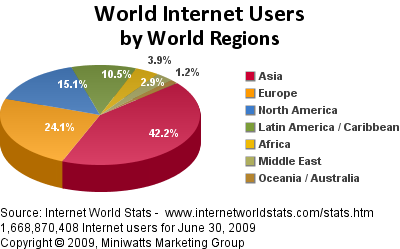 The number of Internet users has more than doubled since the year 2000, and in 2007 there were over 1.1 billion people online worldwide. Web services have shaped youth cultures since mid 1990s, instant communication tools have introduced real time communication culture to masses. Web has also changed the way of working.
New web2.0 companies and web service developers bring forward new services and solutions to be distributed potentially to the "whole world" at once.
Even though the Internet is as common as television and newspaper in many families, still ~80% of world population do not have internet access (or newspaper or television). The estimated number of Internet users in the world for March 31, 2008 is 1 407 724 920 and the penetration is 21.1%, based on the world population estimate of 6 676 120 288 persons for mid-year 2008.
I am currently writing an article together with Dr. Outi Cavén-Pöysä on online youth cultures. More closely we will focus on motivation factors, trust and attitudes towards social networking.
The article will be based on quantitative data from Japan, South Korea and Finland (2006-2007). We decided to focus on these three pioneer countries of the 1990s because at the end of 1990s SMS culture in Finland, iMode craze in Japan and online multiplayer gaming culture in South Korea were something different and never before seen. The article will study if these countries have special qualities to generate novel kind of internet cultures in future as well or would innovations develop anywhere regardless of the history?
According to Paul Budde Communications the Internet is growing at a good rate, but the growth rate is not the same all over the world. The growth rate will not increase until broadband is further developed, and its price rates reduced. Will the Internet penetration have an effect on user innovations or the development of novel web cultures? How much does grass roots innovation, chance and cultural issues have to do with the development? Most likely we will not be able to offer answers to all of those question but I thought of sharing them with you anyhow.
Wednesday, June 25, 2008
Gaming lifestyle and brand parasites
Parteco (Participatory Economy and Beyond: Developing tools and processes for open and participatory knowledge creation and content production) project ended with a Picnic session on 11 June 2008 at Gardenia (Helsinki).
The picnic idea was brilliant - props to Katri Lietsala! Even though the discussion ended up being a bit lame on our blanket the "picnic discussion" was a great format. When I grew tired of the discussion on our blanket, I could easily join other groups or just hang around and enjoy the company.
Katri Lietsala and Esa Sirkkunen published a book on the topic:
Social Media: Introduction to the tools and processes of participatory economy.
Even though I wasn't part of Parteco project I was happy albeit a bit surprised to be invited to give a short presentation on brand parasites at the picnic. The slide set below is not the one I gave at the picnic. Instead I though of collecting "stories" how associations and other actors have utilized the net and understood digital and/or gaming lifestyle of the youth. In this sense brand parasites is just one alternative to meet the crowd and operate online. At Parteco picnic I used Life Tastes Better Without Drugs (EOPH) associations' Hubu project (at Habbo) as an example of brand parasite. The others examples were Anshe Chung (Second Life) and Zipipop (Facebook). I would like to highlight that those were just three randomly chosen examples with an attempt to present different manifestations of "brand parasites".
The picnic idea was brilliant - props to Katri Lietsala! Even though the discussion ended up being a bit lame on our blanket the "picnic discussion" was a great format. When I grew tired of the discussion on our blanket, I could easily join other groups or just hang around and enjoy the company.
Katri Lietsala and Esa Sirkkunen published a book on the topic:
Social Media: Introduction to the tools and processes of participatory economy.
Even though I wasn't part of Parteco project I was happy albeit a bit surprised to be invited to give a short presentation on brand parasites at the picnic. The slide set below is not the one I gave at the picnic. Instead I though of collecting "stories" how associations and other actors have utilized the net and understood digital and/or gaming lifestyle of the youth. In this sense brand parasites is just one alternative to meet the crowd and operate online. At Parteco picnic I used Life Tastes Better Without Drugs (EOPH) associations' Hubu project (at Habbo) as an example of brand parasite. The others examples were Anshe Chung (Second Life) and Zipipop (Facebook). I would like to highlight that those were just three randomly chosen examples with an attempt to present different manifestations of "brand parasites".

Friday, April 25, 2008
Brand embassadors in virtual worlds
Yesterday Finnish online entertainment company Sulake arranged an event focusing on "harnessing youth to act as brand ambassadors". The evening was kicked off by Mr. Jonathan Epstein from in-game advertising firm Double Fusion. Mr. Epstein highlighted five issues that are important when targeting to youth in this entertainment rich, networked society:
1. Include, don’t intrude
2. Keep it personal
3. We are what we shop
4. Fuel the aspiration
5. Focus on ROO (return on objective)
A couple of successful cases were also presented where Sulake products IRC-Galleria and Habbo Hotel were used to reach the right target groups. My absolute favorite was Stabilo case (Lindell). Heli Vainio, brand manager from Lindell gave really inspiring and heartened talk about their experiences at the IRC-Galleria. They looked for new ways to market Stabilo highlighting pens for youngsters. They had their message, the product, manga-drawing competition and some ideas about utilizing the web. They brainstormed with IRC-Galleria guys and came up with an idea of focusing on their Manga drawing competition (banner) and offering "ihq-sälä" (virtual swag) to youth.
They got huge number of drawings to the competition and 30 000 individuals joined the Stabilo community to get virtual Stabilo-branded swag. Lindell increased Stabilo sales to a big bookstore chain by 50%.
MarketingExperiments blog has related post about virtual swag.
Microsoft has also learned to be brave and utilize virtual worlds when launching their new applications. Windows Server 2008, Visual Studio 2008 and SQL Server 2008 will be launched at the Second Life on Saturday, April 26, 2008 at 9:00 A.M. PDT. Microsoft promises to show the applications in action but they also understand the possibility to bring together product experts and techsavvy peers and to enable open discussion.
1. Include, don’t intrude
2. Keep it personal
3. We are what we shop
4. Fuel the aspiration
5. Focus on ROO (return on objective)
A couple of successful cases were also presented where Sulake products IRC-Galleria and Habbo Hotel were used to reach the right target groups. My absolute favorite was Stabilo case (Lindell). Heli Vainio, brand manager from Lindell gave really inspiring and heartened talk about their experiences at the IRC-Galleria. They looked for new ways to market Stabilo highlighting pens for youngsters. They had their message, the product, manga-drawing competition and some ideas about utilizing the web. They brainstormed with IRC-Galleria guys and came up with an idea of focusing on their Manga drawing competition (banner) and offering "ihq-sälä" (virtual swag) to youth.
They got huge number of drawings to the competition and 30 000 individuals joined the Stabilo community to get virtual Stabilo-branded swag. Lindell increased Stabilo sales to a big bookstore chain by 50%.
MarketingExperiments blog has related post about virtual swag.
Microsoft has also learned to be brave and utilize virtual worlds when launching their new applications. Windows Server 2008, Visual Studio 2008 and SQL Server 2008 will be launched at the Second Life on Saturday, April 26, 2008 at 9:00 A.M. PDT. Microsoft promises to show the applications in action but they also understand the possibility to bring together product experts and techsavvy peers and to enable open discussion.
Monday, March 17, 2008
Carbonhero & friends at PixelAche08
I visited Pixelache University ´08 on Saturday at Kiasma (Helsinki Finland). It was nice to see a lot of buzz and people at the sessions. Just to contribute the discussion I would like to rise a few details from the "Travelling without moving" session.
Videoconference system works nicely WHEN it works. This time most of my energy went to filtrating the message from the echo and noise caused by some technical problems. Two of the introductions were held from the distance. First Matt Jones on Doppler and then Daniel Peltz on "Response Call" international video dialogue project.
The presentation on Dopplr (a service for frequent travelers) focused on social networking and linking Dopplr with AMEE platform to calculate ones personal carbon footprint. Call and Response is an international video dialogue project that has engaged media makers in Cameroon, Sweden, Korea, France, South Africa and the U.S. in collective productions aimed at exploring the potential of networked video environments.
After that John Thackara talked briefly about "From Myspace to fakespace". He also put the presentation to his blog. Andreas Zachariah talked about Carbonhero. It was pretty nice mobile app utilizing existing technologies in a novel and innovative way to reveal to its user their own unique Travel Carbon Footprint.
One of the nicest new terms was "brand parasite" coined by Niko Punin. Indeed there are already business "parasites" in virtual services (e.g. Second Life). In this world of open networks, WoM and viral marketing, brand parasites are not that far fetched alternative for the future.
That also reminded me of Virtual World 2008 which will be held in New York at the beginning of April. There is one session focusing on branded virtual goods. That is not really connected to Niko's idea but anyhow... made me to think of "real" and "virtual" brands as well as openness as a part of brand development or brand image.
Videoconference system works nicely WHEN it works. This time most of my energy went to filtrating the message from the echo and noise caused by some technical problems. Two of the introductions were held from the distance. First Matt Jones on Doppler and then Daniel Peltz on "Response Call" international video dialogue project.
The presentation on Dopplr (a service for frequent travelers) focused on social networking and linking Dopplr with AMEE platform to calculate ones personal carbon footprint. Call and Response is an international video dialogue project that has engaged media makers in Cameroon, Sweden, Korea, France, South Africa and the U.S. in collective productions aimed at exploring the potential of networked video environments.
After that John Thackara talked briefly about "From Myspace to fakespace". He also put the presentation to his blog. Andreas Zachariah talked about Carbonhero. It was pretty nice mobile app utilizing existing technologies in a novel and innovative way to reveal to its user their own unique Travel Carbon Footprint.
One of the nicest new terms was "brand parasite" coined by Niko Punin. Indeed there are already business "parasites" in virtual services (e.g. Second Life). In this world of open networks, WoM and viral marketing, brand parasites are not that far fetched alternative for the future.
That also reminded me of Virtual World 2008 which will be held in New York at the beginning of April. There is one session focusing on branded virtual goods. That is not really connected to Niko's idea but anyhow... made me to think of "real" and "virtual" brands as well as openness as a part of brand development or brand image.
Wednesday, March 05, 2008
Communication acrobatics - next generation
Finnish Youth Research Network with our Japanese and South Korean colleagues has collected broad research material on the digital lifestyle of 15-29 year olds in Finland, Japan and South Korea.
At the end of the 1990s, youngsters from these three countries were known as pioneers of digital communication. South Korea was the leading country in online gaming and online communities with extensive network of public PC Pang rooms (net cafés). Finnish youngsters expanded their habitat with the aid of mobile phones and started heavily utilizing SMS messaging as well as “misusing” the mobile for their own purposes. At the same time Japan was already jumping to mobile internet thanks to i-Mode.
After that the rest of the Europe and APAC countries and even the States have catch up. Are there still factors that differentiate these pioneer countries (or youth in these countries) from the others?
Youth researchers have conducted quantitative studies in Japan, South Korea and Finland in 2006-2007. A group of researchers from these countries have formed a network where our aim is to get the most out of the material. Communication Acrobatics -blog was put up in able to communicate the current status of the articles and early research findings to broader audience. The researchers are preparing articles at least in English and Finnish. The articles will be published in late 2008 early 2009.
We hope for active discuss around the topic as well as people to challenge the researchers and ask for further information!
To the Communication Acrobatics -blog
Thursday, December 27, 2007
Mobile-geeky-localized-immersive entertainment
 Nice report from Nokia: Future of Entertainment - global study.
Method:
- 9 000 consumers (16 - 35 year olds)
- 17 correspondents from The Future Laboratory’s LifeSigns Network
- 10 experts
* Data collected July-September 2007
* Report out November 2007
The report has defined and described the trends related to future of entertainment. The future of entertainment is digital, mobile, geeky, immersive, local(ized), ... Actually there are several interesting findings and "most popular" lists for those who are after some views and ideas of the future of (mobile) entertainment. It was interesting to notice that WoW is not on the list of virtual worlds (probably due to Nokia's definition / exclusion) and that Flickr is not until at the third place.
But instead of giving a summary, it would be more useful to read it through from your own viewpoint and draw own conclusions.
Subscribe to:
Posts (Atom)