The business of iGaming (= online money gaming and/or gambling) has changed forever. Internet is normalizing gaming for money and bringing new customers in. At the same time customers are more digital-savvy, expecting more and faster but also willing to take part in building the total experience in return for perceived value. The role of the consumer is being transformed from passive buyer to active co-creator.
The recognition of consumers as active players extends the locus of core competencies from companies inner knowhow to the enhanced network. According to IDC Global’s recent study, 75% of Retailers and 58% of consumer products manufacturers rank consumer centricity among top 3 keys to success. At the Indian Gaming 2009 conference one of the leading slot machine manufacturers, Bally highlighted that: “now more than ever innovations must be built on customer needs and on a solid foundation of dependable, scalable, and efficient technology backed up by strong professional, technical, and customer-support services”. Along the progression of social media business money gaming providers too have to realize that consumers expect more dynamic changes and possibilities to interact and participate than ever before. The huge rise of microblogging service Twitter or social networking service Facebook are good manifestations of this. People want to share, stand out from the crowd and have their opinion heard. In iGaming that is very crucial lesson to be learned. By the general development of the Internet the potential customer is now potentially anyone who finds (money) games interesting.
Competence is a function of the collective knowledge. Ways to make online money games’ interesting is to facilitate dialogue and consumer engagement among dynamic consumer communities and heterogeneous individuals--all eager, and some able, to co-create their own experiences. Consumers are moving toward instant gratification and getting used to the idea of an active dialogue with providers of products and services. Money gaming operators have to utilize that dialogue in design, marketing, consumer support and testing. Additional challenge is speed which is becoming even more central source of competitive advantage. Thing have to happen now, instantly and interactively with the customers.
To adapt and succeed in the current economic environment companies need to build a new set of capabilities: cross-platform innovation, real-time interactive communication channels with consumers, open collaboration and supporting digital processes.
Thursday, April 16, 2009


Monday, April 13, 2009
Adult gamers are boring
Just reading Nielsen report "The state of video gamer - PC game and video game console usage Q4/08". I found this figure interesting. Look at the "Usage min % and Age group. I have assumed that 360 and PS3 compete off the same target group but that is not the case according to Nielsen. Also it is quite surprising that the Wii target group is 6-11 yrs. After all Wii is the family-party-fitness-workplace console. Active user % is also surprisingly high for Wii.
 Additionally:
 Additionally:
 - Good portion of PlayStation 3 console usage occurs during the television prime time hours
- Top games played by 25-54 year old (women or men) are BORING! Someone should help them to find better games from the web ;)
- Most popular PC games are pre-installed Windows card games at the age group of 25-54
- Chessmaster Challenge is getting closer to WoW nr. of unique users - BEWARE!
Wednesday, April 08, 2009
The shape of things to come - IA Inc. map of the net
New version (#4) of the Web Trend Map is out "mapping the 333 most influential web domains and the 111 most influential internet people". They are currently after comments for the draft. If you have something to say, better say it now!

- Pirate Bay has rather impressive building on the map!
- There aren't that many microblogging, gadget/widget stuff on the map. Let's see if the picture will be different next time.
- Additionally I was wondering aren't (teen) virtual worlds influental at all? At least I couldn't find them. Blizzard (WoW) and Disney (line of MMOGs amongst other services) on the map, but Sulake or Neopets/Nickelodeon isn't despite of their (obvious) influence to virtual communities and networking.
- China and Japan are somewhat on the map but Korea isn't. Maybe some Koreans should correct that, after all Korea is the birthplace or capital of MMOGs and home of CyWorld and Baegsoo - both very impressive services.
- Indeed WordPress is so much bigger than Blogger
- Next time I also expect to see some Finnish services on the map (well - Dopplr has some Finns directing the service)
- Barack Obama on the map?!
- Newspapers seem to be pretty nicely on the map (go Aftonbladet!) but for how long... Also do newspapers have better web presence than tv-channels?
Friday, March 27, 2009
Some hope for Danish game development
I am currently living in Denmark where the economical recession is really doing lots of damage. Already at least three very relevant and interesting game companies have had to close their doors due to lack of funding. That’s how it goes – no money – no games I am afraid.
There is something positive though. Limbo project (PlayDead) just got relatively nice funding of 11 million Danish kronas (~1,5 million €). Limbo got funds from Danish CAT Science by RUC, FAHU and Vækstfonden. I get to know Limbo more than a year ago through Nordic Game Program where I am at the Expert group evaluating the applications. Limbo charmed us too but whereas Nordic Game funds are good incentive for the developers it is (naturally) remarkably smaller than VC funds. And without these bigger funds development of a project like Limbo would be so much harder and slower.
But what’s so special about Limbo? First of all it is very much designer / artist driven project. When you look at game video or screen shots it is clear that the visual style is one of the key drivers of the game development. GameDaily wrote an article from IGF09 (btw: Blueberry Garden won – congrats!) where they described the style as “Scandinavian” referring (also) to developers like Petri Purho (Crayon Physic Deluxe), cactus and Niflas (Knytt). Could Limbo’s style be similarly Scandinavian? On the other hand it is a bit Japanese and has certain Ico-feel (black-white, blurred edges, hazyness). Also Samorost comes to my mind for some reason. The story is quite unique (Scandinavian? Remember The Brothers Lionheart / Bröderna Lejonhjärta? – Limbo is about a boy who is looking after his dead little sister in Limbo – mythical space in between heaven and hell.I met Arnt (artist/designer behind Limbo) at the Nordic Game Jam. After meeting the designer the project felt even more clear and justifiable. Limbo seems to be based on a strong vision and demand to keep all the strings at their (PlayDead) own hands. According to Danish press big game companies have contacted PlayDead but they want to stay indie. I have nothing but respect to that – that is the way to innovate and reshape the game industry piece by piece. I hope Limbo will be stimulating Danish game industry, bringing hope to other developers as well.
Sunday, March 01, 2009
IGDA Finland Presentations: Killer games from Finland
If you are in Finland (Helsinki) on March 10th, I would warmly recommend you to join IGDA Finland Presentations session. We have an excellent line-up of speakers talking about iPhone gaming (Zenbound is doing well!), Finnish MMO development (Tweehouse) and indie innovation Crayon Physics Deluxe. It won Seamus McNally Grand Prize last year and is great!
Presentations will be held at Diana auditorio from 5.30 to 7pm. Check out further information from IGDA Finland. After presentations we'll continue the evening at Cuba Café.
Presentations will be held at Diana auditorio from 5.30 to 7pm. Check out further information from IGDA Finland. After presentations we'll continue the evening at Cuba Café.
Wednesday, February 25, 2009
iPhone - the future of mobile gaming?
 According to comScore over 32% iPhone users have downloaded at least one game to their phones. iPhone users differ from random mobile phone users and their user profile is also different but still: gap between 32% and 3,8% (mobile phone users downloaded a game) is huge. Is iPhone the future of mobile gaming and will Apple save developers from porting their games to various mobile platforms?
comScore also shares the following data: 34% of those who downloaded a game in Nov08 used a smart phone. 14% of these are iPhone users. Mobile gaming - especially iPhone gaming - has set up high hopes for the massive growth of mobile gaming revenues. No wonder - the device is cute, it has a big screen, interesting technical features and many iPhone games truly fit well to the casual sector following titles like Bejeweled, Buzz and Zuma.
Still there is room for growth. comScore estimates that 8,5 million per
 sons downloaded mobile games in Nov08 (which is 3,8% of all mobile phone users as mentioned already). 8,5 million might sound a lot but if you compare it to MMS and video messaging (28%), receiving SMS advertising (24%), browsing news (18%) or using e-mail on mobile (17%) it is not that high number after all.
Are iPhone games all about casual fun, mazes and puzzles? Do they have some magic power in them? In a situation where close to 1/4 of iTunes applications are games there ought to be good examples to choose from. iTunes provides different lists but at first it is not clear would ”New and Noteworthy” be better pick than ”What’s Hot”. New and Noteworthy doesn't have any free games. Moreover Hot, Staff Favourites and similar lists evidently promote chargeable games. Top Free Apps (Finland) top 3 is Towerbloxx, Moving Maze3D and Pole Position. But heyhey - these are the same games that are popular in Facebook!?
It soon becomes clear that a typical iPhone game doesn't utilize iPhone's technical features and that the lists are full of console game brands, advergames and iPhone versions of known titles. On the other hand this evidently is the way to go. There is very limited information available about the games. Many free games have a word "free" on their title and the icon should also give some hint what the game is like -- or not. I decided to download Cube Runner because the icon was interesting and Cube Runner sounds like fun. But wait - I expected to get some further information when clicking the icon but instead the game was just added to the Applications list. Next surprise hit when I opened the game. It wasn't anything I expected it to be based on the icon. Instead it reminds me of one poor 3D game I had on my Sony Ericsson back in 2003. Is this it? Where's the magic?
In the name of reasonableness I have to say that this IS the way things tend to evolve on every new platform. First games are golden oldies from 80s or recycled ideas from hit games available on online portals. Well-known brand help players to choose from the set of icons. On the other hand unique or experimental games can get lost in the mass. Marketing-wise one doesn't get too far with awesome icon design or by placing the game to "games" category. Luckily I happen to know one special and unique game which just passed the sieve of Apple. That game is Zenbound (Secret Exit) which truly has magic in it. But when looking at iPhone games in general, I would claim that for the time being the "magic" is largely generated by the device and easy to use Appli store.
Friday, February 20, 2009
Ping.fm testing
Watched Social Gaming Summit 2008 videos http://www.youtube.com/watch?v=JVEIbb0O_vc
Customer acquisition strategies: recommendations, buzz, low entry barrier (easy access). David Perry said 10% users spend money for 3 months.
(And tested Ping.fm but Twitter, Blogger, MySpace, Facebook... are too different from one another. Ping.fm either provides crappy blogs or too long Tweets ;) Good idea anyhow - just have to find how to benefit from it the most).
Customer acquisition strategies: recommendations, buzz, low entry barrier (easy access). David Perry said 10% users spend money for 3 months.
(And tested Ping.fm but Twitter, Blogger, MySpace, Facebook... are too different from one another. Ping.fm either provides crappy blogs or too long Tweets ;) Good idea anyhow - just have to find how to benefit from it the most).
Sunday, February 15, 2009
Pelikone pelikilpailu 2009 (competition)
Hi, just wanted to remind all Finnish readers / indie game developers >> Pelikone competition is on. If you are developing a flash game why not to submit it to the competition?
Friday, February 06, 2009
Monday, February 02, 2009
Nordic Game Jam (Copenhagen)
 Nearly 160 game developers jammed 48 hours during the last weekend in Copenhagen at the Nordic Game Jam (and over 1600 developers around the world!). First Game Jam was arranged at the IT University in Copenhagen in 2006. This year IGDAs Education Special Interest Group got inspired by the event and machinated Global Game Jam network. Over 50 locations take part to the Global Game Jam. The theme was “As Long as we have each other we never run out of problems”. Additionally each location had additional constraints. The constraint for Nordic Game Jam was that the games should be language independent.
Copenhagen had the biggest game jam with nearly 160 participants. People competed in two categories: Bring from Home and Global Game Jam. At the Bring from Home it was ok to bring a game that is 99% finished as long as they work develop, improve or polish the game during the weekend. The theme for the Bring from Home track was humor. The idea at the Global Game Jam track was to just show up with or without a team. The event would start with a brainstorm and group creation session.
The biggest winner of Nordic Game Jam was Make my Head Grow (Denmark). It won best audio, best visuals, innovative controls, audience award at the jury’s award. At the Global Game Jam track In One Piece puzzle game won the audience award and Sheep Away got the jury’s award. Petri Purho (Kloonigames) won the most innovative game title with his 4min33sec which was a tribute to John Cage’s avant garde piece 4´33” from the 1970s. 0 - - 0 had the best audio at the Global Game
 Jam track and Chopper + tank = bees won for the best visuals.
I think Unity could also be listed amongst the winner because Unity was probably the most often used game development tool at NGJ. Check out what type of games were developed during the weekend.
Thursday, January 29, 2009
GuppyLife pre-registration is now open
 GuppyLife will be released in English shortly. The pre-registration is now open! GuppyLife is a MMO / virtual world targeted at tween girls. It has been out in Danish since October 2008. GuppyLife has several unique features starting with the 3D style and Guppy AI. If you are interested to know more, check out GuppyLife.com and pre-register to the grand opening of the English version of GuppyLife.
Friday, January 16, 2009
Measuring and visualizing the Internet
Lately I have been checking out Quantcast internet statistic tool and IBM's Many Eyes data visualization tool. I have to give props to both -- both of them are really interesting and valuable tools for many. At Twitter  I gave some criticism to Quantcast regarding provided data about gender of the users. Even if it is hard to get exact information of the female and male users at a particular web service, Quantcast gives a lot of very interesting data / estimations. Definitely worth checking out.
I didn't play with IBMs Many Eyes myself, just checked out what type of visualizations other users have done so far. I searched "internet" related data and got a long list of graphs from internet penetration to use of web services. Check out the pics. Naturally one challenge with internet-related data is that data about web services from 2007 means the data is already badly outdated. The other pic "age vs. internet use" is an autobiography but it inspired me to look for similar data. We did an extensive survey on youth and social internet in Japan, South Korea and Finland. The data was gathered 2006-2007. Should be possible to look at different age groups (from 15 to 29), compare them with each other and generate similar maps of the data. I already know there are big differences between teens and 20-something when it comes to use IM vs. e-mail. Supposedly social networking and online gaming would also make differences between age groups or genders. I have to do my own Many Eyes and post the data to my blog at least!
 I gave some criticism to Quantcast regarding provided data about gender of the users. Even if it is hard to get exact information of the female and male users at a particular web service, Quantcast gives a lot of very interesting data / estimations. Definitely worth checking out.
I didn't play with IBMs Many Eyes myself, just checked out what type of visualizations other users have done so far. I searched "internet" related data and got a long list of graphs from internet penetration to use of web services. Check out the pics. Naturally one challenge with internet-related data is that data about web services from 2007 means the data is already badly outdated.
 The other pic "age vs. internet use" is an autobiography but it inspired me to look for similar data. We did an extensive survey on youth and social internet in Japan, South Korea and Finland. The data was gathered 2006-2007. Should be possible to look at different age groups (from 15 to 29), compare them with each other and generate similar maps of the data. I already know there are big differences between teens and 20-something when it comes to use IM vs. e-mail. Supposedly social networking and online gaming would also make differences between age groups or genders. I have to do my own Many Eyes and post the data to my blog at least!
Friday, January 09, 2009
% of girlgamers on the rise - 31% of WoW players female
 I spent some time browsing comScores data from 08. Lately I have been looking at MMOs and girls' online activities. I have posted quite a few messages to Twitter on the subject (check out souplala if you are interested to find some data about girls' online activities and MMOs).
comScore also provides somewhat interesting data regarding girl gamers. They indicate significant user growth among teenage girls between the ages of 12 and 17 and women between the ages of 55 and 64.

I was also a bit surprised that no more than 31% of WoW users are female but considering the huge number of players (nearly 12M) it might not be that surprising after all?
 The last graph is not 100% relevant for this post but I though of putting it there anyhow. Even if it does not talk about gaming or SNSs it nicely highlights some differences between female and male consumers. If consuming virtual items is anyway in line with this it reveals something about general interests and potential activities online.
Thursday, December 18, 2008
Thursday, December 11, 2008
HOTTEST trends in games 2009
The year 2008 is coming to its end and it is time to look ahead. I have been evaluating bunch of game concepts this year, visited GDC and other industry events, chatted at IGDA, reviewed several games and of course followed what’s going on at the game scene. It is always nice to guess what might be coming up. Thus here are my top 5 trends for 2009 which I believe will have an effect to the games development and/or culture.
1. Tinkering in games
Game editors and users’ tools for altering the game world will become even more common on web and in games. In 2008 I got to review several ideas focusing on coloring or drawing and games utilizing the camera. PS EyePet will most probably be one of the most visible embodiments of this but there are also lots of other concepts utilizing the same idea. Would this be (finally) the time when camera interface takes off? We have had EyeToy and projects like KukaKumma Muumaassa but would EyePet and similar ideas push pattern recognition and/or camera interaction into mainstream? Coloring is another "coming up stong" thing. Drawn to Life and Grayon Physics Deluxe are already out there and I have seen many – especially children’s games’ – ideas focusing on drawing and coloring. When talking about tinkering, Little Big Planet and XNA could be added to this list as well. These are few steps closer to mainstream UGC in games than mod’s, hacks or Game Editor type of tools for creating games.
2. Networked experiences (game communities) for nichés
MMO scene is relatively occupied but not yet saturated. Niché products and online game communities targeted to specific target groups (based on demographics, interests etc.) are been put together. When talking about niché users, keep in mind that in an online environment niché can easily be a lot of people. There are 400M broadband users in the world (Source: Broadband Forum) and according to Strategic Analyst there are ~137M active online community accounts out there. When looking at the total number of registered users e.g. in Shanda games (700M), Habbo (100M) or SL (16M) it seems that the users are starting to find their place in the online worlds. The search and try-once period is over and people start to know what to look for. This means that the stickiness of an online community will become more central. This leads us to the next point.
3. Revenue models and payment methods diversify
Online (game) communities are no longer about the number of registered users but about [this is] living :) Where as earlier the number of registered users was highlighted, now the focus is on stickiness, value for the users, uniqueness and interactivity. Online communities are introducing dual (Habbo.com, GuppyLife.com) or triple currencies (whirled.com). Time spent and activity in increasingly relevant.
4. Massive competitive co-op FPSs (and potentially other genres)
There seem to be a need for scalable co-op games -- something in between of "playing with friends" and MMOs. Resistance 2 (perhaps also CoD) is one example of a shared experience and collaborative gaming in a scalable and/or flexible game environment.
5. Network mini games adding value
So far gamers have been able to download additions to games via Live Arcade, PSN or Wii store. For example Fable 2 connects with Xbox Live Arcade pub games. One can play the games and win virtual money in pub games and use them at Fable 2. I don’t mean this idea would be one of the next big trends but the idea of creating a link between network games and console games sounds interesting. The link could be in a form of a comment or response in the vein of Youtube or just additions, extensions and (UG) reactions.
You might ask why I don’t have any mobile trends on the list and where are all VR, AR, pervasive games etc. related trends. Well, mobile is a part of the networked experience. Also I think we are in between of JavaBrewFlash and locative / pervasive games. Pervasive games are not there yet. Stand alones on the other hand are here already. I do believe iPhone will enable novel types of gaming but would it evolve some new trends? At the moment iPhone is providing and will provide some small and funny stuff but nothing groundbreaking.
Then again the nice thing about trends is that I am just guessing. Prove me wrong, argue against my ponderings or suggest your own.
1. Tinkering in games
Game editors and users’ tools for altering the game world will become even more common on web and in games. In 2008 I got to review several ideas focusing on coloring or drawing and games utilizing the camera. PS EyePet will most probably be one of the most visible embodiments of this but there are also lots of other concepts utilizing the same idea. Would this be (finally) the time when camera interface takes off? We have had EyeToy and projects like KukaKumma Muumaassa but would EyePet and similar ideas push pattern recognition and/or camera interaction into mainstream? Coloring is another "coming up stong" thing. Drawn to Life and Grayon Physics Deluxe are already out there and I have seen many – especially children’s games’ – ideas focusing on drawing and coloring. When talking about tinkering, Little Big Planet and XNA could be added to this list as well. These are few steps closer to mainstream UGC in games than mod’s, hacks or Game Editor type of tools for creating games.
2. Networked experiences (game communities) for nichés
MMO scene is relatively occupied but not yet saturated. Niché products and online game communities targeted to specific target groups (based on demographics, interests etc.) are been put together. When talking about niché users, keep in mind that in an online environment niché can easily be a lot of people. There are 400M broadband users in the world (Source: Broadband Forum) and according to Strategic Analyst there are ~137M active online community accounts out there. When looking at the total number of registered users e.g. in Shanda games (700M), Habbo (100M) or SL (16M) it seems that the users are starting to find their place in the online worlds. The search and try-once period is over and people start to know what to look for. This means that the stickiness of an online community will become more central. This leads us to the next point.
3. Revenue models and payment methods diversify
Online (game) communities are no longer about the number of registered users but about [this is] living :) Where as earlier the number of registered users was highlighted, now the focus is on stickiness, value for the users, uniqueness and interactivity. Online communities are introducing dual (Habbo.com, GuppyLife.com) or triple currencies (whirled.com). Time spent and activity in increasingly relevant.
4. Massive competitive co-op FPSs (and potentially other genres)
There seem to be a need for scalable co-op games -- something in between of "playing with friends" and MMOs. Resistance 2 (perhaps also CoD) is one example of a shared experience and collaborative gaming in a scalable and/or flexible game environment.
5. Network mini games adding value
So far gamers have been able to download additions to games via Live Arcade, PSN or Wii store. For example Fable 2 connects with Xbox Live Arcade pub games. One can play the games and win virtual money in pub games and use them at Fable 2. I don’t mean this idea would be one of the next big trends but the idea of creating a link between network games and console games sounds interesting. The link could be in a form of a comment or response in the vein of Youtube or just additions, extensions and (UG) reactions.
You might ask why I don’t have any mobile trends on the list and where are all VR, AR, pervasive games etc. related trends. Well, mobile is a part of the networked experience. Also I think we are in between of JavaBrewFlash and locative / pervasive games. Pervasive games are not there yet. Stand alones on the other hand are here already. I do believe iPhone will enable novel types of gaming but would it evolve some new trends? At the moment iPhone is providing and will provide some small and funny stuff but nothing groundbreaking.
Then again the nice thing about trends is that I am just guessing. Prove me wrong, argue against my ponderings or suggest your own.
Thursday, December 04, 2008
(A bit silly view of) Future entertainment

The vision is a bit silly (IMHO) and some future ideas on this pic are already outdated or implemented but anyhow... 2017 orgasm by e-mail? Why e-mail if we can use video, IM or cybersex gear? I remember experiencing a weird CU-SeeMe striptease act when I tried the CU-SeeMe system some 10 years ago. And I believe we do not have to wait until 2017 to experience first divorce due to virtual affair either.
Wednesday, December 03, 2008
Chatting with myself after work
At the moment I am pondering how to create value in a casual game community service and how to reach a certain niché. Content is the usual suspect when talking about certain gender or age group but it seems to be more and more important how communities involve, enchant and involve the users. The “right” ways vary from community to community.
I met a group of deco (Decorative Friendship Book) swappers some years ago. Putting deco books together was really charming and girly hobby for me. The idea of “decoing” is to start a book (with empty pages), decorate first page and send it to a friend. A friend will then add her decoration and send it forward and so on. When the book is done it will return to the one who started that book. Deco is more art and design heavy but still somewhat related to other types of hobby crafts. Etsy must be the mainstream of the trend focusing on handmade items in general where as Smilebox is an interesting niché site focusing on scrapbooks. All of the mentioned hobbies are rather girly ones. Correct me if I am wrong but I would suppose most likely the majority of deco, Etsy or Smilebox user are women. It is interesting to see that in online games and/or communities guys are often the most active ones putting up fan web sites, hacking and altering the world if possible and doing different caricatures of the characters or other fan art.
I met a group of deco (Decorative Friendship Book) swappers some years ago. Putting deco books together was really charming and girly hobby for me. The idea of “decoing” is to start a book (with empty pages), decorate first page and send it to a friend. A friend will then add her decoration and send it forward and so on. When the book is done it will return to the one who started that book. Deco is more art and design heavy but still somewhat related to other types of
 hobby crafts. Etsy must be the mainstream of the trend focusing on handmade items in general where as Smilebox is an interesting niché site focusing on scrapbooks. All of the mentioned hobbies are rather girly ones. Correct me if I am wrong but I would suppose most likely the majority of deco, Etsy or Smilebox user are women. It is interesting to see that in online games and/or communities guys are often the most active ones putting up fan web sites, hacking and altering the world if possible and doing different caricatures of the characters or other fan art.
Despite the different target groups it is also interesting how similar the motivational factors are. Social is usually at the core of the experience – doing things together, sharing, collaborating or communicating but also issues related to appearance, relaxation, entertainment (of course) and competence are often mentioned. Even if there are similar motivational factors, girls and boys seem to value different type of involvement and creativity in games or in relation to games. Perhaps LBP type of creativity is too design heavy even though creating levels is sort of tinkering – the same way as Smilebox and deco activities -- and rather easy as well. But maybe it is not the creation but more about the value what one gets from creating things? Maybe the expectations and/or needs are different?
Friday, November 28, 2008
How to get funding for a game idea?
I have been reviewing game concepts e.g. for the Nordic Game Program (NGP). There are still few lessons to be learned when it comes to pitching a game. My wish is of course to see as many Finnish application on the next round of NGP as possible, thus I though of sharing some ideas which might be useful and helpful for those applying funds for the game production.
Here we go:
1. Follow the instructions
If there is a form, use it and follow the instructions. Do not add any convincing mumbo-jumbo if not asked. Also if an attachment should be 5 pages at the maximum then it is 5 pages max!
2. Credibility
Make sure you have a team which is capable of doing everything you describe at the application. Tell about the business and/or distribution plan. If you have already discussed with some publishers, do not forgot to mention that. Too often there are just vague "online distribution", "pc, xbox, DS, PSP or perhaps mobile" or "Nintendo Wii with 50/50 deal". Eh, yes? Are you sure or perhaps... not?
3. Make the basics very clear
What is the game idea, which platforms, distribution channels, what's the budget, revenue model(s), originality, target group, mechanics, business potential and milestones? Why you are working with this idea? Less and well structured content is more.
4. Application is a written pitch
Think about the application as a whole. It should be easy to read and easy to understand. Picture tells more than 1000 words. Graphics is a way to stand out and add credibility to your application.
5. Address potential problems
Be realistic. The biggest problem cannot be "if we do not get funding, we will not be able to make this game". There are always challenges and problems. Try to address key challenges in beforehand. Perhaps the underlying magic aka technology will generate challenges, maybe marketing is the weakers link? That too will add credibility.
Here we go:
1. Follow the instructions
If there is a form, use it and follow the instructions. Do not add any convincing mumbo-jumbo if not asked. Also if an attachment should be 5 pages at the maximum then it is 5 pages max!
2. Credibility
Make sure you have a team which is capable of doing everything you describe at the application. Tell about the business and/or distribution plan. If you have already discussed with some publishers, do not forgot to mention that. Too often there are just vague "online distribution", "pc, xbox, DS, PSP or perhaps mobile" or "Nintendo Wii with 50/50 deal". Eh, yes? Are you sure or perhaps... not?
3. Make the basics very clear
What is the game idea, which platforms, distribution channels, what's the budget, revenue model(s), originality, target group, mechanics, business potential and milestones? Why you are working with this idea? Less and well structured content is more.
4. Application is a written pitch
Think about the application as a whole. It should be easy to read and easy to understand. Picture tells more than 1000 words. Graphics is a way to stand out and add credibility to your application.
5. Address potential problems
Be realistic. The biggest problem cannot be "if we do not get funding, we will not be able to make this game". There are always challenges and problems. Try to address key challenges in beforehand. Perhaps the underlying magic aka technology will generate challenges, maybe marketing is the weakers link? That too will add credibility.
Friday, November 21, 2008
Technologizing youth and Finnish game market in a nutshell
I visited National Board of Education a week ago and got to know KenGuru site which tries to offer a one-stop-shop for teachers on topics related to digital media (e.g. media use, education and learning). Even if the site is not 100% 2.0 (or actually quite far from it) I like the idea and found some very relevant content for teachers who practically do not have enough time or personal interest to get in depth with all the web services, interaction methods or keywords which are everyday to their students. Of course visual presentation would be even better. The event was targeted to teachers. I talked about the media use in general and about different roles youngsters take in virtual communities and interactive services. The presentation was partly based on a report I together with The Finnish Society on Media Education did a couple of weeks ago for the Ministry of Transport and Communications Finland. The goal of the report is to give the basics to educators, parents, politics etc. in a nutshell. The focus of that report is digital media and the age group is under 18 year olds. I can provide a summary in English if you like.
I also visited one event where I learned that there is something like 30 - 40 000 WoW players in Finland (~10 million worldwide). WoW is The mainstream of MMOGs and almost every other is playing WoW but still 40 000 is quite a bit in a country of 5 million inhabitants. Other interesting numbers from Figma (Finnish Games and Multimedia Association) were e.g. that 67% of Finnish gamers play online and 31% of parents play with their children. Even though that is quite low number I was actually surprised how high it is. According to Figma figures 36% of 16-29 year olds play digital games. When we (research group) conducted a survey through Taloustutkimus (market research web panel) in 2006 (N was almost 1500) 20% of girls and ~70% of boys in the age group of 13-18 year olds, played games daily or almost daily. Naturally when the age is closer to 30 children, work, hobbies and other activities consume bigger and bigger part of the spare time. What I found interesting is that still people highlight how the average player in Finland is 37-or-so years old male but when looking at gaming from hobby perspective the youngsters rule. Who cares about Minesweeper or Solitaire! Lately educators have gotten interested in games or game-like solutions in education. When there is interest there most likely will (soon) be solutions. That is super! It will be interesting to see how different schools start to utilize games or game-like processes in learning. Ludocraft from Oulu has been developing Novicraft solution. Naturally the other way to go is to utilize existing leisure games or other playful and easy to use online tools.
I also visited one event where I learned that there is something like 30 - 40 000 WoW players in Finland (~10 million worldwide). WoW is The mainstream of MMOGs and almost every other is playing WoW but still 40 000 is quite a bit in a country of 5 million inhabitants. Other interesting numbers from Figma (Finnish Games and Multimedia Association) were e.g. that 67% of Finnish gamers play online and 31% of parents play with their children. Even though that is quite low number I was actually surprised how high it is. According to Figma figures 36% of 16-29 year olds play digital games. When we (research group) conducted a survey through Taloustutkimus (market research web panel) in 2006 (N was almost 1500) 20% of girls and ~70% of boys in the age group of 13-18 year olds, played games daily or almost daily. Naturally when the age is closer to 30 children, work, hobbies and other activities consume bigger and bigger part of the spare time. What I found interesting is that still people highlight how the average player in Finland is 37-or-so years old male but when looking at gaming from hobby perspective the youngsters rule. Who cares about Minesweeper or Solitaire! Lately educators have gotten interested in games or game-like solutions in education. When there is interest there most likely will (soon) be solutions. That is super! It will be interesting to see how different schools start to utilize games or game-like processes in learning. Ludocraft from Oulu has been developing Novicraft solution. Naturally the other way to go is to utilize existing leisure games or other playful and easy to use online tools.
Tuesday, October 28, 2008
Seminar on game design and usability in Helsinki
Those who are not at the Igda-mailing list but are interested in games design and usability issues, this event might be interesting for you?
From the Igda.fi:
Would you like to know what Insomniac has learned from Ratchet & Clank or Resistance: Fall of Man on game usability and interaction design? How to test mobile and online game community MoiPal? What are the best usability and interaction design practices at Sulake?
Welcome to IGDA Finland Presentation session organized in association
with SIGCHI, Remedy Games and Sulake! This time the theme is game interaction design and usability.
We have a mind blowing lineup of speakers:
Ryan Schneider (Insomniac)
Ryan works as Community Director at Insomniac. Insomniac is famous for Ratchet & Clank series and Resistance: Fall of Man which was one of the PS3 launch titles.
Joakim Achren (IronStarHelsinki)
Joakim is the CEO of IronStarHelsinki. Ironstar Helsinki is the first company in the world to have successfully launched a cross-platform game that allows branded virtual goods in both online and mobile environments.
Inka Vikman (Sulake)
Inka works as Concept Designer at Sulake. Sulake is an online entertainment company focused on virtual worlds and social networking. They run popular online community service Habbo in 32 countries.
Olli Sinermä (Heavy Metal Helsinki / Pelit magazine)
Olli works as lead designer and game analyst. He will talk about usability from game reviewer's viewpoint.
After the presentations we will have open microphone session where YOU can give quick presentations (max 5 minutes) on your usability challenges or solutions! If you would like to have you 15 seconds of fame: let us know by 6th November. E-mail: sonja.kangas@igda.fi
NOTE: This time pre-registration to the IGDA Finland Presentations session is mandatory. Please register at: http://igda.fi/?page_id=16
The IGDA gathering aka after party is at Cuba cafe!
* IGDA FINLAND PRESENTATION *
Place: Valkoinen sali, Aleksanterinkatu 16-18, follow the IGDA signs
Date: Tuesday 11th November
Starts: 16.00
Ends: 19.00 — the chat will continue at Cuba cafe!
* IGDA FINLAND AUGUST GATHERING & AFTER PARTY *
Place: Cuba Cafe, Erottajankatu 4, 00120 Helsinki (map: http://igda.fi/?page_id=5 )
Time: Tuesday 11th November, doors open at 19.00
From the Igda.fi:
Would you like to know what Insomniac has learned from Ratchet & Clank or Resistance: Fall of Man on game usability and interaction design? How to test mobile and online game community MoiPal? What are the best usability and interaction design practices at Sulake?
Welcome to IGDA Finland Presentation session organized in association
with SIGCHI
We have a mind blowing lineup of speakers:
Ryan Schneider (Insomniac)
Ryan works as Community Director at Insomniac. Insomniac is famous for Ratchet & Clank series and Resistance: Fall of Man which was one of the PS3 launch titles.
Joakim Achren (IronStarHelsinki)
Joakim is the CEO of IronStarHelsinki. Ironstar Helsinki is the first company in the world to have successfully launched a cross-platform game that allows branded virtual goods in both online and mobile environments.
Inka Vikman (Sulake)
Inka works as Concept Designer at Sulake. Sulake is an online entertainment company focused on virtual worlds and social networking. They run popular online community service Habbo in 32 countries.
Olli Sinermä (Heavy Metal Helsinki / Pelit magazine)
Olli works as lead designer and game analyst. He will talk about usability from game reviewer's viewpoint.
After the presentations we will have open microphone session where YOU can give quick presentations (max 5 minutes) on your usability challenges or solutions! If you would like to have you 15 seconds of fame: let us know by 6th November. E-mail: sonja.kangas@igda.fi
NOTE: This time pre-registration to the IGDA Finland Presentations session is mandatory. Please register at: http://igda.fi/?page_id=16
The IGDA gathering aka after party is at Cuba cafe!
* IGDA FINLAND PRESENTATION *
Place: Valkoinen sali, Aleksanterinkatu 16-18, follow the IGDA signs
Date: Tuesday 11th November
Starts: 16.00
Ends: 19.00 — the chat will continue at Cuba cafe!
* IGDA FINLAND AUGUST GATHERING & AFTER PARTY *
Place: Cuba Cafe, Erottajankatu 4, 00120 Helsinki (map: http://igda.fi/?page_id=5 )
Time: Tuesday 11th November, doors open at 19.00
Tuesday, October 21, 2008
Children & Youth - media use in a nutshell
Hello world. Lately I have been writing "Children's and youth and their media use - in a nutshell" report together with The Finnish Society of Media Education. It has been a challenge to describe the youngsters' media landscape to the assumed readers. For those who do not spend time at the internet -- except reading e-mails or surfing at "Google" -- it is difficult to express that internet is actually many things. It is not just one. It is both data transmission network and a platform for many services. Or that the graphical browser environment is not the totality of the internet. Or that internet is not done. It has relatively short history and the development is in connection with the technical and cultural evolvement. I am really pleased with the result. The report will be put out on Friday -- keep your eyes open if you are interested to check it out. I will post the report to my blog as well.
A couple of days ago I met one soon-to-be internet idol: Marko Forss aka -fobba-. He started "neighbourhood police" activity at the popular IRC-Galleria online community in September. The experiment has been a solid success. Today it is Tuesday and -fobba- is offline but nearly 1500 persons have already visited his profile page this week! It was really interesting to hear how police have been accepted within the online community and what type of best practises has he already found. Besides -fobba- case we have several excellent web pilot cases here in Finland. Check out my presentation at the Slideshare to get an idea of the range of experiments to combine commercial services with communal / public activities.
Besides work: I have been playing Little Big Planet and I have to say I really adore that game and the Sackdude. The game is SO funny, cute, interesting, challenging, diverse... MM really did a great job with the game. Related to games I could also mention that 11 of November will be a special IGDA Finland Presentations session. If you are interested in game design and usability -- keep your eyes open. We will have something special for you :)
As a final note I though of mentioning that I will be working with a MMO / online community project called Guppylife.
A couple of days ago I met one soon-to-be internet idol: Marko Forss aka -fobba-. He started "neighbourhood police" activity at the popular IRC-Galleria online community in September. The experiment has been a solid success. Today it is Tuesday and -fobba- is offline but nearly 1500 persons have already visited his profile page this week! It was really interesting to hear how police have been accepted within the online community and what type of best practises has he already found. Besides -fobba- case we have several excellent web pilot cases here in Finland. Check out my presentation at the Slideshare to get an idea of the range of experiments to combine commercial services with communal / public activities.
Besides work: I have been playing Little Big Planet and I have to say I really adore that game and the Sackdude. The game is SO funny, cute, interesting, challenging, diverse... MM really did a great job with the game. Related to games I could also mention that 11 of November will be a special IGDA Finland Presentations session. If you are interested in game design and usability -- keep your eyes open. We will have something special for you :)
As a final note I though of mentioning that I will be working with a MMO / online community project called Guppylife.
Friday, October 10, 2008
Blogging at Tilt.tv
I have started writing a blog for Tilt.tv in Finnish. Those interested in games related discussion should check it out. The other Tilt blogger is MMO-guru Susi. So far I have been writing about Will Wright, educational games and user generated content.
Spore was released a couple of weeks ago. A week ago I met professor James Paul Gee and Elizabeth Hayes in Helsinki. We had a good talk about educational games and gender issues in games. During this week I have been playing Little Big Planet (oooh, it is so lovely!), partying with IGDA-dudes and doing some preparations because I am moving to Copenhagen after two weeks.
Oh, and I also had a good talk with a friend of mine about exergames. In 2005 I predicted that exergame markets are expected to grow signally within 5 years. My friend questioned if exergames will anyhow remain marginal. Sure we have Nintendo Wii Fit and some dance gaming but where's the beef? How to really generate new business out of that? Since then I have been pondering the case and will write about it next time. Soon -- I promise!
Spore was released a couple of weeks ago. A week ago I met professor James Paul Gee and Elizabeth Hayes in Helsinki. We had a good talk about educational games and gender issues in games. During this week I have been playing Little Big Planet (oooh, it is so lovely!), partying with IGDA-dudes and doing some preparations because I am moving to Copenhagen after two weeks.
Oh, and I also had a good talk with a friend of mine about exergames. In 2005 I predicted that exergame markets are expected to grow signally within 5 years. My friend questioned if exergames will anyhow remain marginal. Sure we have Nintendo Wii Fit and some dance gaming but where's the beef? How to really generate new business out of that? Since then I have been pondering the case and will write about it next time. Soon -- I promise!
Thursday, September 04, 2008
Social media is not new - it is next
Within the last few days I have met teachers who try to utilize digital media at school and understand more about edugames, media literacy specialists pondering common policies and solutions in different European countries and social media geeks, hangarounds and wannabe's wondering how social media will change our society and work cultures.
I am involved in many networks where I either just hangaround and spend time or share ideas and experiences with the others. Even though I like to chat and share stuff with people over the net, you really can’t beat seeing and chatting with people IRL. So thanks again to you all for excellent discussions and delicious dinners ;)
- Interesting learning games coming up which focus on team work
- Exergames can also be stealth learning (learning by doing)
- Soon everything (object) will be connected providing new possibilities for learning
- Social media is nothing we should adjust to, neither it is a new challenge. Social media is next (not new).
- Copies have no value, value is in the noncopyable. Value is linked with speed and focus on details
- Immediacy & personalization
- Media is liquid?
- Social networks as informants not necessarily one person (anonymous group)
- Flattened levels of information. Information value will accumulate (of course not all types of information). Blogs and newspaper are at the same level (at e.g. iGoogle)
- Focus on nodes of information > authority
- Social media = more than community features and user generated content. It is about congregating, compilation, grouping, commenting.

I am involved in many networks where I either just hangaround and spend time or share ideas and experiences with the others. Even though I like to chat and share stuff with people over the net, you really can’t beat seeing and chatting with people IRL. So thanks again to you all for excellent discussions and delicious dinners ;)
Some points I found interesting:
- Interesting learning games coming up which focus on team work
- Exergames can also be stealth learning (learning by doing)
- Soon everything (object) will be connected providing new possibilities for learning
- Social media is nothing we should adjust to, neither it is a new challenge. Social media is next (not new).
- Copies have no value, value is in the noncopyable. Value is linked with speed and focus on details
- Immediacy & personalization
- Media is liquid?
- Social networks as informants not necessarily one person (anonymous group)
- Flattened levels of information. Information value will accumulate (of course not all types of information). Blogs and newspaper are at the same level (at e.g. iGoogle)
- Focus on nodes of information > authority
- Social media = more than community features and user generated content. It is about congregating, compilation, grouping, commenting.
Tuesday, August 26, 2008
Mä oon täällä (I am here) online service is finally out
 Nuori Suomi (The Young Finland Association) has been working with an online service for children & youth. The starting point of the service is well in focus: the site should motivate people to be active and exercise as well as share their sports related experiences within the community. Street sports and snowboarding are just some examples where filming already is a part of fun. "Mä oon täällä" web site tries to teach youngsters who are more into traditional sport to upload their best moments to the service and see what type of reaction they will get from the crowd.
It will be interesting to see what type of sports will be the most popular and the most common ones at the service. Perhaps the youngsters will take the service to whole new direction? Most often hanging around the mall or doing some tricks with friends is not exercise in the traditional sense but it is casual exercise and everyday activity anyhow. The web site is also supporting small groups who organize their own events. "Mä oon täällä" site can be used as a channel to find interesting sports related events and network with like-minded.
The web site is linked with "World Record School Break" and "Youth 2011" campaigns which will be organized by The Young Finland Association.
Friday, July 11, 2008
Huge growth potential for online services
According to InternetStats: 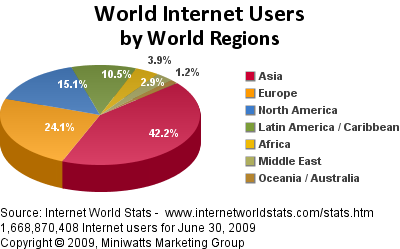 The number of Internet users has more than doubled since the year 2000, and in 2007 there were over 1.1 billion people online worldwide. Web services have shaped youth cultures since mid 1990s, instant communication tools have introduced real time communication culture to masses. Web has also changed the way of working.
The number of Internet users has more than doubled since the year 2000, and in 2007 there were over 1.1 billion people online worldwide. Web services have shaped youth cultures since mid 1990s, instant communication tools have introduced real time communication culture to masses. Web has also changed the way of working.New web2.0 companies and web service developers bring forward new services and solutions to be distributed potentially to the "whole world" at once.
Even though the Internet is as common as television and newspaper in many families, still ~80% of world population do not have internet access (or newspaper or television). The estimated number of Internet users in the world for March 31, 2008 is 1 407 724 920 and the penetration is 21.1%, based on the world population estimate of 6 676 120 288 persons for mid-year 2008.
I am currently writing an article together with Dr. Outi Cavén-Pöysä on online youth cultures. More closely we will focus on motivation factors, trust and attitudes towards social networking.
The article will be based on quantitative data from Japan, South Korea and Finland (2006-2007). We decided to focus on these three pioneer countries of the 1990s because at the end of 1990s SMS culture in Finland, iMode craze in Japan and online multiplayer gaming culture in South Korea were something different and never before seen. The article will study if these countries have special qualities to generate novel kind of internet cultures in future as well or would innovations develop anywhere regardless of the history?
According to Paul Budde Communications the Internet is growing at a good rate, but the growth rate is not the same all over the world. The growth rate will not increase until broadband is further developed, and its price rates reduced. Will the Internet penetration have an effect on user innovations or the development of novel web cultures? How much does grass roots innovation, chance and cultural issues have to do with the development? Most likely we will not be able to offer answers to all of those question but I thought of sharing them with you anyhow.
Wednesday, June 25, 2008
Gaming lifestyle and brand parasites
Parteco (Participatory Economy and Beyond: Developing tools and processes for open and participatory knowledge creation and content production) project ended with a Picnic session on 11 June 2008 at Gardenia (Helsinki).
The picnic idea was brilliant - props to Katri Lietsala! Even though the discussion ended up being a bit lame on our blanket the "picnic discussion" was a great format. When I grew tired of the discussion on our blanket, I could easily join other groups or just hang around and enjoy the company.
Katri Lietsala and Esa Sirkkunen published a book on the topic:
Social Media: Introduction to the tools and processes of participatory economy.
Even though I wasn't part of Parteco project I was happy albeit a bit surprised to be invited to give a short presentation on brand parasites at the picnic. The slide set below is not the one I gave at the picnic. Instead I though of collecting "stories" how associations and other actors have utilized the net and understood digital and/or gaming lifestyle of the youth. In this sense brand parasites is just one alternative to meet the crowd and operate online. At Parteco picnic I used Life Tastes Better Without Drugs (EOPH) associations' Hubu project (at Habbo) as an example of brand parasite. The others examples were Anshe Chung (Second Life) and Zipipop (Facebook). I would like to highlight that those were just three randomly chosen examples with an attempt to present different manifestations of "brand parasites".
The picnic idea was brilliant - props to Katri Lietsala! Even though the discussion ended up being a bit lame on our blanket the "picnic discussion" was a great format. When I grew tired of the discussion on our blanket, I could easily join other groups or just hang around and enjoy the company.
Katri Lietsala and Esa Sirkkunen published a book on the topic:
Social Media: Introduction to the tools and processes of participatory economy.
Even though I wasn't part of Parteco project I was happy albeit a bit surprised to be invited to give a short presentation on brand parasites at the picnic. The slide set below is not the one I gave at the picnic. Instead I though of collecting "stories" how associations and other actors have utilized the net and understood digital and/or gaming lifestyle of the youth. In this sense brand parasites is just one alternative to meet the crowd and operate online. At Parteco picnic I used Life Tastes Better Without Drugs (EOPH) associations' Hubu project (at Habbo) as an example of brand parasite. The others examples were Anshe Chung (Second Life) and Zipipop (Facebook). I would like to highlight that those were just three randomly chosen examples with an attempt to present different manifestations of "brand parasites".

Monday, June 16, 2008
The first 15 years of girlgames
I wrote (/am writing) an article of the first 15 years of girlgames. The article is still a draft but I would love to hear your comments about it.


Thursday, June 05, 2008
Top 20 Most Anticipated Games of E3 by GS
GameSpot has announced its list of the top 20 most anticipated games of E3.
The Top 20 Most Anticipated Games of E3 were chosen based on a multitude of criteria: GameSpot editorial opinions, consumer polls, blogosphere buzz, and general consumer interest surrounding titles.
GameSpot's 20 Most Anticipated Games (listed in alphabetical order not in order of importance) are as follows:
The Top 20 Most Anticipated Games of E3 were chosen based on a multitude of criteria: GameSpot editorial opinions, consumer polls, blogosphere buzz, and general consumer interest surrounding titles.
GameSpot's 20 Most Anticipated Games (listed in alphabetical order not in order of importance) are as follows:
- Command & Conquer: Red Alert 3 (EA)
- Fable 2 (Lionhead)
- Fallout 3 (Bethesda)
- Far Cry 2 (Ubisoft)
- Gears of War 2 (EPIC)
- Lego Batman (Warner Bros. Interactive)
- Killzone (SCEA)
- Little Big Planet (SCEA)
- Madden NFL 09 (EA)
- Mortal Kombat v. DC Universe (Midway)
- Motor Storm Pacific Rift (SCEA)
- Resident Evil 5 (Capcom)
- Resistance 2 (SCEA)
- Saint's Row (THQ)
- Soulcalibur IV (Namco)
- Spore (EA)
- Star Wars: The Force Unleashed (Lucas Arts)
- The Sims 3 (EA)
- Tomb Raider Underworld (Eidos)
- WarHammer Online (EA)
Wednesday, May 28, 2008
Casual games business models
Casual Connect Magazine had pretty informative article on casual games business models. Here are some points from the article. The article described 6 business models for casual games.
1) Advertising-Supported Games. There are four alternatives: 1) In-Game, 2) Around-game, 3) Product placement and 4) Advergames. In-Game Ads refer to dynamic advertising containers in the game. Around-game advertising cover ads which appear on top of, before or after the game experience. E.g. banners belong to this category. Product Placement -- yep, game character use Nike shoes and drink Pepsi and Advergames are games that serve as advertisements. Burger King advergames are one of my favorite ones.
Benefits of advertising-supported games are that they are dynamic, interactive and they overcome the payment barrier. On the other hand push-back from players is a very real worry. Many gamers feel that ad supported products should be cheaper. When doing badly they can also disrupt the game experience. Also not every game really suits to advertising. Think about WoW type of games having advertisements of modern products hangings from the trees.
 2) Retail games is always an option. Game publishers sell the games, one by one, to consumers. In this digital age physical brick-and-mortar can become a challenge. Then again Nintendo Wii and other physical game consoles and games are doing very well at the moment. From the viewpoint of casual games which are often smaller games (shorter, smaller file size etc.) fit better to digital distribution. According to Casual Connect the audience fragmentation has resulted in the emergence of specialty online stores which are dedicated to specific genres of games.
Retail games (physically and digitally distributed) have a broad audience. According to the article 200 million people play casual games and spend over $2.5 billion on them in 2008. Retail represents a channel for getting games in front of people e.g. at department stores. Weakness might be the challenges of retail (price, logistics etc.). Would casual games hit the premium shelf at the store - maybe not? Retailers need to stock fast-selling inventory and are unwilling to take unknown genres or lesser-known brands.
3) Subscription services is the third alternative. For a regular monthly or annual fee, the subscriber gets unlimited access to certain content, usually in the form of deluxe downloadable games. On the positive side only a small portion of people purchase more than one game via the dominant trial-to-purchase model whereas subscription services can enable ongoing revenue streams. On the negative side subscription services require maintenance.
4) Virtual object purchase has been in the headlines for several years already. Some claim that to be already bigger source of income than in-game advertisements or similar. The strengths: high margin model for developers.
The most expensive part of game development is the initial product launch. New content can bring people back to a title or keep them interested. Digital objects give gamers the ability to control their purchasing experience by presenting options for content. Downloadable content can also be a welcome break and boost to team morale after the time intensive development processes associated with core titles. Weaknesses include payment methods. Margins are easily eroded by credit card transaction fees. A large catalog of digital goods can create a paradox of coice. It can also add complexity to the game (grey market, selling-buying etc.).
5) Skill gaming referring to games which is determined by player's skill is yet another alternative. Standardized IP and existing market are strengths of this alternative. Weaknesses include regulatory threats and possibilities for fraud. Real money increases the attractiveness of skill games for hackers and cheats. It is proximity gaming after all and moral as well as political debate is undergoing.
6) Pay-per-play maps a game session to a cost just like in game arcades. The pricing model is flexible which makes players spend easily several quarters for the game focusing just on games like. One can try before buying the game. Weaknesses include cannibalization, consumer comfort and mode complicated purchasing.
1) Advertising-Supported Games. There are four alternatives: 1) In-Game, 2) Around-game, 3) Product placement and 4) Advergames. In-Game Ads refer to dynamic advertising containers in the game. Around-game advertising cover ads which appear on top of, before or after the game experience. E.g. banners belong to this category. Product Placement -- yep, game character use Nike shoes and drink Pepsi and Advergames are games that serve as advertisements. Burger King advergames are one of my favorite ones.
Benefits of advertising-supported games are that they are dynamic, interactive and they overcome the payment barrier. On the other hand push-back from players is a very real worry. Many gamers feel that ad supported products should be cheaper. When doing badly they can also disrupt the game experience. Also not every game really suits to advertising. Think about WoW type of games having advertisements of modern products hangings from the trees.
 2) Retail games is always an option. Game publishers sell the games, one by one, to consumers. In this digital age physical brick-and-mortar can become a challenge. Then again Nintendo Wii and other physical game consoles and games are doing very well at the moment. From the viewpoint of casual games which are often smaller games (shorter, smaller file size etc.) fit better to digital distribution. According to Casual Connect the audience fragmentation has resulted in the emergence of specialty online stores which are dedicated to specific genres of games.
Retail games (physically and digitally distributed) have a broad audience. According to the article 200 million people play casual games and spend over $2.5 billion on them in 2008. Retail represents a channel for getting games in front of people e.g. at department stores. Weakness might be the challenges of retail (price, logistics etc.). Would casual games hit the premium shelf at the store - maybe not? Retailers need to stock fast-selling inventory and are unwilling to take unknown genres or lesser-known brands.
3) Subscription services is the third alternative. For a regular monthly or annual fee, the subscriber gets unlimited access to certain content, usually in the form of deluxe downloadable games. On the positive side only a small portion of people purchase more than one game via the dominant trial-to-purchase model whereas subscription services can enable ongoing revenue streams. On the negative side subscription services require maintenance.
4) Virtual object purchase has been in the headlines for several years already. Some claim that to be already bigger source of income than in-game advertisements or similar. The strengths: high margin model for developers.
The most expensive part of game development is the initial product launch. New content can bring people back to a title or keep them interested. Digital objects give gamers the ability to control their purchasing experience by presenting options for content. Downloadable content can also be a welcome break and boost to team morale after the time intensive development processes associated with core titles. Weaknesses include payment methods. Margins are easily eroded by credit card transaction fees. A large catalog of digital goods can create a paradox of coice. It can also add complexity to the game (grey market, selling-buying etc.).
5) Skill gaming referring to games which is determined by player's skill is yet another alternative. Standardized IP and existing market are strengths of this alternative. Weaknesses include regulatory threats and possibilities for fraud. Real money increases the attractiveness of skill games for hackers and cheats. It is proximity gaming after all and moral as well as political debate is undergoing.
6) Pay-per-play maps a game session to a cost just like in game arcades. The pricing model is flexible which makes players spend easily several quarters for the game focusing just on games like. One can try before buying the game. Weaknesses include cannibalization, consumer comfort and mode complicated purchasing.
Friday, May 23, 2008
Bye bye game arcades?
 I was just reading the news from intergameonline:
"Japan's US$6.9bn arcade industry has been hit hard by new advances in home console gaming, particularly Nintendo's hugely popular Wii.
Unlike many countries where the rise of Sony's PlayStation during the 1990s wreaked havoc on the industry, Japan's arcades were more resilient, helped by a greater variety of machines and plentiful foot traffic in crowded cities. But now some of the biggest chains are shutting many of their outlets."
While visiting Japan and Korea I always enjoy checking out weird and funny arcade games such as Drummania or this wok-game for example. Certainly there is room for innovation in others areas (home game consoles, handhelds etc.) as well but still you can't beat the feeling of a game arcade full of gamers playing shooting, riding, cooking and ball-kicking games together with their friends :)Friday, May 16, 2008
Everyone likes to play
 Greetings from Helsinki, Berlin and Malmö!
 I have been enjoying good company as well as joined interesting seminars and conferences lately. Here is a short sum up of the last few weeks.
In Berlin I enjoyed Rodeo Club/Restaurant (nice dinner!) and checked out Typical! Chichés of Jews and Others exhibition held at Jewish Museum in Berlin. From there the exhibition will go to Chicago and Vienna. Even though I didn't find the exhibition that strong as a whole there were several very good examples of preconceptions and differences in perceiving foreign cultures. One of my favorite artwork was a wall-projected video collage of hilarious posters and advertisements from the past.

Varjomailma website tries to make it easy to share stories and create a cartoon of ones own. Sisko Salo-Chydenius gave a nice talk about stories and storytelling and highlighted factors which are important in games too. Story (or a game) is not a reflection of the world as such but a view, vision where the action is often presented in a form of a battle between good and evil. Story can help children to think of their actions and consequences. One can also get consolation or different experiences from the stories. Described setting is not univocal truth but stories are space for dreams and magic (in comparison to real life as “work”). I think that was nicely put and would also work for games.

 There was quite a bit of talk about casual games and the shift from "1980s game genres" to novel ones which might also interest non-gamers. The change of games industry came through in various panel discussions and presentations. They discussed about a games as performance, as containers, as services, games as a way to socially interact with people, as a hobby... and so on. If nothing else, games certainly are in the mainstream and innovative game concepts can evolve outside Japan, too ;)
Friday, April 25, 2008
Brand embassadors in virtual worlds
Yesterday Finnish online entertainment company Sulake arranged an event focusing on "harnessing youth to act as brand ambassadors". The evening was kicked off by Mr. Jonathan Epstein from in-game advertising firm Double Fusion. Mr. Epstein highlighted five issues that are important when targeting to youth in this entertainment rich, networked society:
1. Include, don’t intrude
2. Keep it personal
3. We are what we shop
4. Fuel the aspiration
5. Focus on ROO (return on objective)
A couple of successful cases were also presented where Sulake products IRC-Galleria and Habbo Hotel were used to reach the right target groups. My absolute favorite was Stabilo case (Lindell). Heli Vainio, brand manager from Lindell gave really inspiring and heartened talk about their experiences at the IRC-Galleria. They looked for new ways to market Stabilo highlighting pens for youngsters. They had their message, the product, manga-drawing competition and some ideas about utilizing the web. They brainstormed with IRC-Galleria guys and came up with an idea of focusing on their Manga drawing competition (banner) and offering "ihq-sälä" (virtual swag) to youth.
They got huge number of drawings to the competition and 30 000 individuals joined the Stabilo community to get virtual Stabilo-branded swag. Lindell increased Stabilo sales to a big bookstore chain by 50%.
MarketingExperiments blog has related post about virtual swag.
Microsoft has also learned to be brave and utilize virtual worlds when launching their new applications. Windows Server 2008, Visual Studio 2008 and SQL Server 2008 will be launched at the Second Life on Saturday, April 26, 2008 at 9:00 A.M. PDT. Microsoft promises to show the applications in action but they also understand the possibility to bring together product experts and techsavvy peers and to enable open discussion.
1. Include, don’t intrude
2. Keep it personal
3. We are what we shop
4. Fuel the aspiration
5. Focus on ROO (return on objective)
A couple of successful cases were also presented where Sulake products IRC-Galleria and Habbo Hotel were used to reach the right target groups. My absolute favorite was Stabilo case (Lindell). Heli Vainio, brand manager from Lindell gave really inspiring and heartened talk about their experiences at the IRC-Galleria. They looked for new ways to market Stabilo highlighting pens for youngsters. They had their message, the product, manga-drawing competition and some ideas about utilizing the web. They brainstormed with IRC-Galleria guys and came up with an idea of focusing on their Manga drawing competition (banner) and offering "ihq-sälä" (virtual swag) to youth.
They got huge number of drawings to the competition and 30 000 individuals joined the Stabilo community to get virtual Stabilo-branded swag. Lindell increased Stabilo sales to a big bookstore chain by 50%.
MarketingExperiments blog has related post about virtual swag.
Microsoft has also learned to be brave and utilize virtual worlds when launching their new applications. Windows Server 2008, Visual Studio 2008 and SQL Server 2008 will be launched at the Second Life on Saturday, April 26, 2008 at 9:00 A.M. PDT. Microsoft promises to show the applications in action but they also understand the possibility to bring together product experts and techsavvy peers and to enable open discussion.
Friday, April 18, 2008
...and we have the Pelixi winners!
Pelixi is a game concept and demo competition for Finnish children and youth under 21 year of age. The competition was arranged by The Centre of School Clubs.
The best game concept and game demo were awarded today at Heureka Science Center. Game concept Nivium won the grand prix of Pelixi concept category and Kiertoradalla (On the Orbit) game demo category. The idea of Nivium is to generate snowflakes from crystal pieces. The game is a rhythm game where the player has to tap the buttons at right time and at right order. There are various shapes, colors and sizes of crystals and different shapes create different sounds. The player will be awarded by the complexity, aesthetics and musical aspects of the snowflake. For Toshio Iwai fans Nivium most likely reminds a bit of Electroplankton game made for Nintendo DS and influenced by Toshio Iwai's earlier media art pieces such as "Composition on the Table" and "Sim Tunes".
On the Orbit is a game where the player has to do various tasks at the Space Ship. Some of the tasks will be carried out in a quiz format. The game could be interesting "learning environment" for space enthusiasts but also pleasant casual game.
Eight game concepts or demos were awarded at the competition. It was interesting to see how many game concepts obviously were influenced by Pokemon, The Sims or different racing games. It was also a bit pity that only four girls participating the competition but interesting to see that girls' games were quite stereotypical "pay it forward" friendship adventures where as boys' games were often versions of their favorite games or game types.
The results of the competition in Finnish.
The best game concept and game demo were awarded today at Heureka Science Center. Game concept Nivium won the grand prix of Pelixi concept category and Kiertoradalla (On the Orbit) game demo category. The idea of Nivium is to generate snowflakes from crystal pieces. The game is a rhythm game where the player has to tap the buttons at right time and at right order. There are various shapes, colors and sizes of crystals and different shapes create different sounds. The player will be awarded by the complexity, aesthetics and musical aspects of the snowflake. For Toshio Iwai fans Nivium most likely reminds a bit of Electroplankton game made for Nintendo DS and influenced by Toshio Iwai's earlier media art pieces such as "Composition on the Table" and "Sim Tunes".
On the Orbit is a game where the player has to do various tasks at the Space Ship. Some of the tasks will be carried out in a quiz format. The game could be interesting "learning environment" for space enthusiasts but also pleasant casual game.
Eight game concepts or demos were awarded at the competition. It was interesting to see how many game concepts obviously were influenced by Pokemon, The Sims or different racing games. It was also a bit pity that only four girls participating the competition but interesting to see that girls' games were quite stereotypical "pay it forward" friendship adventures where as boys' games were often versions of their favorite games or game types.
The results of the competition in Finnish.
Friday, April 11, 2008
Helsinki Media Conference 2008
I attended the Helsinki Media Conference event for the first time. The event is mainly for journalists and marketing people. This time there was a lot of talks about blurry concepts such as web2.0.
If you can Finnish, there are excellent Jaiku reports available from the event. For the rest of you here are some points I found interesting.
Andrew Keen talked about web2.0 but never really explained what he meant with it. He was upset that people upload videos to YouTube but do not get any money out of it. Perhaps people are after other ways to "benefit" from their videos?
It was also a bit worrying to hear that (as far as I understood his view) Mr. Keen saw bloggers as an alternative to mass communication. I would say they are primarily an addition to mass media and enrich the data by sharing their personal opinions about something.
Sami Salmenkivi talked about funny social networking / viral marketing case. It was exciting to realize that it would only take a small group of enthusiasts to get into the game and ready to go out and do whatever the Joker asks AND they would get hundreds of thousands of viewers to the "real life episodes". Impressive.
I also learned that you can reach half of 12-19 year old Finnish teenage girls via Demi magazine & website and 75% of 15-24 year old Finns use IRC-Galleria. For Demi magazine online community has become a vital source of information about trends, interests and phenomenon. I am more and more surprised that for example music magazine Suosikki or techie-mag Tekniikan maailma do not utilize communities and/or different groups of users any more efficiently.
Erik Norin gave a really nice presentation of FarFar ad agency. He gave examples of "ongoing marketing campaign model" and talked about Heidies but even more interesting example was a campaign their did for Nokia. They created quite funny Stavros character who is into "position art". Check out the website and you'll get the point. Ongoing model focuses on flexibility, adaptivity, discussion and creating a relationship with the customer. Mr. Norin showed how one could extend the lifespan of a campaign by enabling the consumers to take part of it for example by contributing questions, suggestions, answers... to the campaign.
In my presentation the main points were:
- the "information and communication layers" are flattening both contact and demand-wise. Facebook and Google HomePage both flatten the layers. Facebook does it by including various ways (both public and one to one) communication under one "community" and by flattening different acquaintances to one level. Google HomePage by giving the power to the user to mix and match various sources from information to one level and one layout -- anything from web diaries to personal blogs and official web news portals.
- There are three characteristics how youth use digital media: 1) communication acrobatics, 2) multitasking and 3) snack culture.
- My presentation:
If you can Finnish, there are excellent Jaiku reports available from the event. For the rest of you here are some points I found interesting.
Andrew Keen talked about web2.0 but never really explained what he meant with it. He was upset that people upload videos to YouTube but do not get any money out of it. Perhaps people are after other ways to "benefit" from their videos?
It was also a bit worrying to hear that (as far as I understood his view) Mr. Keen saw bloggers as an alternative to mass communication. I would say they are primarily an addition to mass media and enrich the data by sharing their personal opinions about something.
Sami Salmenkivi talked about funny social networking / viral marketing case. It was exciting to realize that it would only take a small group of enthusiasts to get into the game and ready to go out and do whatever the Joker asks AND they would get hundreds of thousands of viewers to the "real life episodes". Impressive.
I also learned that you can reach half of 12-19 year old Finnish teenage girls via Demi magazine & website and 75% of 15-24 year old Finns use IRC-Galleria. For Demi magazine online community has become a vital source of information about trends, interests and phenomenon. I am more and more surprised that for example music magazine Suosikki or techie-mag Tekniikan maailma do not utilize communities and/or different groups of users any more efficiently.
Erik Norin gave a really nice presentation of FarFar ad agency. He gave examples of "ongoing marketing campaign model" and talked about Heidies but even more interesting example was a campaign their did for Nokia. They created quite funny Stavros character who is into "position art". Check out the website and you'll get the point. Ongoing model focuses on flexibility, adaptivity, discussion and creating a relationship with the customer. Mr. Norin showed how one could extend the lifespan of a campaign by enabling the consumers to take part of it for example by contributing questions, suggestions, answers... to the campaign.
In my presentation the main points were:
- the "information and communication layers" are flattening both contact and demand-wise. Facebook and Google HomePage both flatten the layers. Facebook does it by including various ways (both public and one to one) communication under one "community" and by flattening different acquaintances to one level. Google HomePage by giving the power to the user to mix and match various sources from information to one level and one layout -- anything from web diaries to personal blogs and official web news portals.
- There are three characteristics how youth use digital media: 1) communication acrobatics, 2) multitasking and 3) snack culture.
- My presentation:
Thursday, April 03, 2008
All Finnish girl gamers unite!
The third "girl gamers" night was organized yesterday. The first two sessions were actually Rock band sessions at the REAL bands' rehearsal studio at Iso Roba in Helsinki. I loved the idea of having those plastic instruments in the studio and see what the "real" guitar heroes say about it (!) I actually asked about that but apparently the guys were not too interested in finding out what the girls were doing there and who the F*** is playing Ride the Lightning at full volume (with plastic instruments ;)
Anyhow yesterday there were 10+ of us present at Microsoft office in Espoo. Games like Halo, Scene It?, Rock Band, a dance game, Viva Pinâta etc. were played amongst enjoying good food, drinks and company.
It was nice to see such a range of girls and women present from 15-year old game geeks to women working at game stores, to marketing specialists, journalists and researcher/designer. Besides game playing we also talked (enthusiastically!) about women's role in game communities and prejudices towards girl gamers -- but also about the pleasure women get when they can show their superior gaming skills over boys and men :D Especially when those girlgamers who were present yesterday were not "the typical casual, social gamers" or The Sims fans but Rainbow Six, flight simulator or Halo players, guitar hero gurus and shooter specialists.
We had a lot of fun! The next session will be Wii-evening organized by Nintendo. If there are Finnish girl gamers who would like to chat with like-minded, you are most welcome to join us. Send me a message or join FB group "Pelinaiset".
Anyhow yesterday there were 10+ of us present at Microsoft office in Espoo. Games like Halo, Scene It?, Rock Band, a dance game, Viva Pinâta etc. were played amongst enjoying good food, drinks and company.
It was nice to see such a range of girls and women present from 15-year old game geeks to women working at game stores, to marketing specialists, journalists and researcher/designer. Besides game playing we also talked (enthusiastically!) about women's role in game communities and prejudices towards girl gamers -- but also about the pleasure women get when they can show their superior gaming skills over boys and men :D Especially when those girlgamers who were present yesterday were not "the typical casual, social gamers" or The Sims fans but Rainbow Six, flight simulator or Halo players, guitar hero gurus and shooter specialists.
We had a lot of fun! The next session will be Wii-evening organized by Nintendo. If there are Finnish girl gamers who would like to chat with like-minded, you are most welcome to join us. Send me a message or join FB group "Pelinaiset".
Thursday, March 27, 2008
Wikinomics and collaborative publishing
I spent the afternoon at a workshop organized by Sitra. It focused on the future of the Internet. This was actually our second workshop out of four. We are building a foresight "report" which will be ready in summer08. This time Anthony Williams who is the co-author of Wikinomics - How Mass Collaboration Changes Everything book (2007) started the session.
In his talk he focused on four aspects: web2.0, Net Generation, social revolution and economical revolution. Before getting into the topics, we learned that his company New Paradigm is currently focusing on anything and everything ending with 2.0. It is a bit annoying to hear these version numbers while at the same the speaker stresses the role of the users. Why they do not talk about change in mode or style of use instead of empty/multifarious catchwords and 101000110-language? Also is this (the current web) really the second version of the Internet? I tend to disagree.
Anyhow, the talk itself was too overall, too obvious and not too innovative from my viewpoint. BUT it did raise some ideas and questions which I am just going to list here.
NETGEN
- Is it useful to coin different terms for generations (x, y, c, Millennials, iGen, NetGen...) or perhaps try to describe the change in how people have learned to use the net, what are the factors for cultural change, how much that actually is a question of generations of users?
- Don't get me wrong, I like to categorize youth into generations as well (to be able to focus better on one mass and/or highlight some changes) but that should not be the only thing to look at because there are clear differences within youth which might e.g. relate to location (country side/city, central/remote, cultural differences etc.)
- Is it cool to say that you do not read newspapers?
- Is it because of the medium or wrong type of content? Both?
- What will be the generation after Net Generation? When? How does it differ from NetGen?
- Demographic aging in North America & Europe vs. India, China and African countries
- Is the number of youth in correlation with innovativeness?
- How much innovativeness is related to cultural atmosphere and various enablers?

3D WEB
- Mr. Williams was convinced that the future of the web will be "multimedia 3D". I totally agree with multimedia but what's the case with 3D? Aren't we expecting to get involved real time, anywhere, anytime and as conveniently as possible?
- What is the role of 3D environments in the business life?
- Companies certainly look for ways to utilize blogs, wikis, Jaikus, etc.
- Does the new modes of operation include 3D?
- Open innovation in 3D?
- Who would like to use 3D via a cell phone?
REVOLUTION
- Isn't revolution intially social?
- Why it has to be revolution [instead of e.g. evolution]?
- Paradigm shift.
In his talk he focused on four aspects: web2.0, Net Generation, social revolution and economical revolution. Before getting into the topics, we learned that his company New Paradigm is currently focusing on anything and everything ending with 2.0. It is a bit annoying to hear these version numbers while at the same the speaker stresses the role of the users. Why they do not talk about change in mode or style of use instead of empty/multifarious catchwords and 101000110-language? Also is this (the current web) really the second version of the Internet? I tend to disagree.
Anyhow, the talk itself was too overall, too obvious and not too innovative from my viewpoint. BUT it did raise some ideas and questions which I am just going to list here.
NETGEN
- Is it useful to coin different terms for generations (x, y, c, Millennials, iGen, NetGen...) or perhaps try to describe the change in how people have learned to use the net, what are the factors for cultural change, how much that actually is a question of generations of users?
- Don't get me wrong, I like to categorize youth into generations as well (to be able to focus better on one mass and/or highlight some changes) but that should not be the only thing to look at because there are clear differences within youth which might e.g. relate to location (country side/city, central/remote, cultural differences etc.)
- Is it cool to say that you do not read newspapers?
- Is it because of the medium or wrong type of content? Both?
- What will be the generation after Net Generation? When? How does it differ from NetGen?
- Demographic aging in North America & Europe vs. India, China and African countries
- Is the number of youth in correlation with innovativeness?
- How much innovativeness is related to cultural atmosphere and various enablers?
3D WEB
- Mr. Williams was convinced that the future of the web will be "multimedia 3D". I totally agree with multimedia but what's the case with 3D? Aren't we expecting to get involved real time, anywhere, anytime and as conveniently as possible?
- What is the role of 3D environments in the business life?
- Companies certainly look for ways to utilize blogs, wikis, Jaikus, etc.
- Does the new modes of operation include 3D?
- Open innovation in 3D?
- Who would like to use 3D via a cell phone?
REVOLUTION
- Isn't revolution intially social?
- Why it has to be revolution [instead of e.g. evolution]?
- Paradigm shift.
Monday, March 17, 2008
Carbonhero & friends at PixelAche08
I visited Pixelache University ´08 on Saturday at Kiasma (Helsinki Finland). It was nice to see a lot of buzz and people at the sessions. Just to contribute the discussion I would like to rise a few details from the "Travelling without moving" session.
Videoconference system works nicely WHEN it works. This time most of my energy went to filtrating the message from the echo and noise caused by some technical problems. Two of the introductions were held from the distance. First Matt Jones on Doppler and then Daniel Peltz on "Response Call" international video dialogue project.
The presentation on Dopplr (a service for frequent travelers) focused on social networking and linking Dopplr with AMEE platform to calculate ones personal carbon footprint. Call and Response is an international video dialogue project that has engaged media makers in Cameroon, Sweden, Korea, France, South Africa and the U.S. in collective productions aimed at exploring the potential of networked video environments.
After that John Thackara talked briefly about "From Myspace to fakespace". He also put the presentation to his blog. Andreas Zachariah talked about Carbonhero. It was pretty nice mobile app utilizing existing technologies in a novel and innovative way to reveal to its user their own unique Travel Carbon Footprint.
One of the nicest new terms was "brand parasite" coined by Niko Punin. Indeed there are already business "parasites" in virtual services (e.g. Second Life). In this world of open networks, WoM and viral marketing, brand parasites are not that far fetched alternative for the future.
That also reminded me of Virtual World 2008 which will be held in New York at the beginning of April. There is one session focusing on branded virtual goods. That is not really connected to Niko's idea but anyhow... made me to think of "real" and "virtual" brands as well as openness as a part of brand development or brand image.
Videoconference system works nicely WHEN it works. This time most of my energy went to filtrating the message from the echo and noise caused by some technical problems. Two of the introductions were held from the distance. First Matt Jones on Doppler and then Daniel Peltz on "Response Call" international video dialogue project.
The presentation on Dopplr (a service for frequent travelers) focused on social networking and linking Dopplr with AMEE platform to calculate ones personal carbon footprint. Call and Response is an international video dialogue project that has engaged media makers in Cameroon, Sweden, Korea, France, South Africa and the U.S. in collective productions aimed at exploring the potential of networked video environments.
After that John Thackara talked briefly about "From Myspace to fakespace". He also put the presentation to his blog. Andreas Zachariah talked about Carbonhero. It was pretty nice mobile app utilizing existing technologies in a novel and innovative way to reveal to its user their own unique Travel Carbon Footprint.
One of the nicest new terms was "brand parasite" coined by Niko Punin. Indeed there are already business "parasites" in virtual services (e.g. Second Life). In this world of open networks, WoM and viral marketing, brand parasites are not that far fetched alternative for the future.
That also reminded me of Virtual World 2008 which will be held in New York at the beginning of April. There is one session focusing on branded virtual goods. That is not really connected to Niko's idea but anyhow... made me to think of "real" and "virtual" brands as well as openness as a part of brand development or brand image.
Thursday, March 13, 2008
SOE looking for girl gamers / designers

Oh boy, it is good to be a girl! Sony Online Entertainment LLC (SOE) conducted a survey on women and video games. That is no news because “women & games” has been topical for 15 years already. What is interesting though is that SOE announced scholarship program with The Art Institutes designed to educate and recruit more women into the video game industry. One might say that this emphasize being a girl as invalidity. On the other hand SOE gives special benefit for girls. Take the most out of it then?!
According to SOE: “SOE G.I.R.L. Gamers In Real Life” scholarship is the first of its kind with The Art Institutes to encourage students toward career paths in the creative and applied arts, ultimately resulting in the development of games that are more interesting for women to play. The only problem is that it is only valid in the States. Find out more from the website.
Even though you might not qualify as an applicant you might be interested in hearing what their survey revealed:
* 61% of students surveyed believe male dominance in the industry is a deterrent to women pursuing a career in gaming
* 42% of those surveyed would like to see women portrayed as leaders in video games
* 35% of the students surveyed want to create more games that are fun and interesting for women to play
* 31% of those surveyed want to become involved in gaming because more women need to represent the industry.
I find the results quite puzzling and a bit surprising. Personally I know quite a lot of women from the game industry but have not heard that much about problems due to male dominance. Also I would have liked to hear that 31 % want to become involved in gaming because they find the industry innovative, inspiring and full of opportunities. Or because they want to become the next Peter Molyneux or Will Wright :)
Anyhow – SOE G.I.R.L. sounds like a good opportunity, I give virtual waves for SOE!
Wednesday, March 05, 2008
Communication acrobatics - next generation
Finnish Youth Research Network with our Japanese and South Korean colleagues has collected broad research material on the digital lifestyle of 15-29 year olds in Finland, Japan and South Korea.
At the end of the 1990s, youngsters from these three countries were known as pioneers of digital communication. South Korea was the leading country in online gaming and online communities with extensive network of public PC Pang rooms (net cafés). Finnish youngsters expanded their habitat with the aid of mobile phones and started heavily utilizing SMS messaging as well as “misusing” the mobile for their own purposes. At the same time Japan was already jumping to mobile internet thanks to i-Mode.
After that the rest of the Europe and APAC countries and even the States have catch up. Are there still factors that differentiate these pioneer countries (or youth in these countries) from the others?
Youth researchers have conducted quantitative studies in Japan, South Korea and Finland in 2006-2007. A group of researchers from these countries have formed a network where our aim is to get the most out of the material. Communication Acrobatics -blog was put up in able to communicate the current status of the articles and early research findings to broader audience. The researchers are preparing articles at least in English and Finnish. The articles will be published in late 2008 early 2009.
We hope for active discuss around the topic as well as people to challenge the researchers and ask for further information!
To the Communication Acrobatics -blog
Tuesday, February 26, 2008
My top 5 from GDC08
1. Community
In-game and common social interaction and community features were key theme at the GDC08. Microsoft explained how XNA game studio would democratize game development and distribution. I totally agree with Russ Pitts's report at the Escapist: "The silence in the room said more than (Christopher) Satchell could have in twenty more minutes. It was as if every single developer was thinking "if anyone can make games ... what am I going to do?". Despite the fact user generated content and peer-group communities are already here. Also e.g. Spore was much into community and user generated content is coming out in September.
2. Machinima
Several companies were providing tools for machinima developers at the expo floor. For example Korean I-TONIC company had developed a Kloseup.com game community within which players could utilize their favourite game characters to create short movies.
3. Sims success
TheSimsCarnival online community is out on beta. All Sims fans should check it out! EA also announced the Sims to hit a 100 million mark soon.
4. Fable2
Peter Molyneux disclosed Fable 2 to contain dynamic co-op gaming and possibility to get money for doing quests, doing jobs and for gambling. Especially the idea of linking an Xbox live arcade game with Fable 2 was interesting. A player coulg gamble (with fake money) online and transfer that as credits/gold to Fable.
5. Casual games
In his keynote, Playfirst CEO John Welch envisioned an opportunity to elevate video games to become a first-tier form of entertainment, like TV. The goal is reached when 'casual games' goes away as a category, and 'hard-core games' is the niche. I am not that sure about that but nevertheless casual games were everywhere from Facebook gaming to online casual game portals and advergaming.
In-game and common social interaction and community features were key theme at the GDC08. Microsoft explained how XNA game studio would democratize game development and distribution. I totally agree with Russ Pitts's report at the Escapist: "The silence in the room said more than (Christopher) Satchell could have in twenty more minutes. It was as if every single developer was thinking "if anyone can make games ... what am I going to do?". Despite the fact user generated content and peer-group communities are already here. Also e.g. Spore was much into community and user generated content is coming out in September.
2. Machinima
Several companies were providing tools for machinima developers at the expo floor. For example Korean I-TONIC company had developed a Kloseup.com game community within which players could utilize their favourite game characters to create short movies.
3. Sims success
TheSimsCarnival online community is out on beta. All Sims fans should check it out! EA also announced the Sims to hit a 100 million mark soon.
4. Fable2
Peter Molyneux disclosed Fable 2 to contain dynamic co-op gaming and possibility to get money for doing quests, doing jobs and for gambling. Especially the idea of linking an Xbox live arcade game with Fable 2 was interesting. A player coulg gamble (with fake money) online and transfer that as credits/gold to Fable.
5. Casual games
In his keynote, Playfirst CEO John Welch envisioned an opportunity to elevate video games to become a first-tier form of entertainment, like TV. The goal is reached when 'casual games' goes away as a category, and 'hard-core games' is the niche. I am not that sure about that but nevertheless casual games were everywhere from Facebook gaming to online casual game portals and advergaming.
Friday, February 15, 2008
Development Support for Nordic Games -new round starts
From Nordic Game:
A total of 6 million Danish crowns (DKK) have been granted for development support to Nordic game companies in 2008, and the available funds will be allocated over two application rounds. The application deadline for the first round is 24:00 (midnight) on 1 April 2008
The projects that are granted funding in the first round will be presented at the Nordic Game 2008 conference in Malmö on the 14-15 May.
More information about the program from Nordic Game Program website. See you all at Nordic Game Conference 2008!
A total of 6 million Danish crowns (DKK) have been granted for development support to Nordic game companies in 2008, and the available funds will be allocated over two application rounds. The application deadline for the first round is 24:00 (midnight) on 1 April 2008
The projects that are granted funding in the first round will be presented at the Nordic Game 2008 conference in Malmö on the 14-15 May.
More information about the program from Nordic Game Program website. See you all at Nordic Game Conference 2008!
Wednesday, February 13, 2008
Play + innovation
Playpump is an interesting innovation and a solution to a number of water-related problems. It is no news that any innovation which would solve the water problem in third world countries is a key to improve people's lives in the area. It just is not that simple... but Playpump innovation is really cleaver. It focuses on quality of life and fun which is -- as such -- already one solution to the problem. Also it does not only look at the problem but more of the everyday life and the context of the problem, motivational factors and values.
I wish this inspires you to think of play and/or games similarly in different context -- as a part of bigger solutions or innovations which do not necessarily have be "save the world" type of ideas but which could make a difference.
I wish this inspires you to think of play and/or games similarly in different context -- as a part of bigger solutions or innovations which do not necessarily have be "save the world" type of ideas but which could make a difference.
Friday, February 01, 2008
Any good living lab models out there?
In Finland many research projects got public funding (by Tekes, EU etc.). Funding is linked with personal experience (=longer courier and better business network) and/or enthusiasm; "sisu" (guts) to come up with a good R&D consortium. Too often the result is just another report or a prototype which will never be utilized commercially. That is because researchers get more steady income and more opportunities for experimenting at a research institution and companies have not really put that much effort to the project because it is publicly funded. Also some companies lack strategic solutions and operational model on how to turn a prototype into a product. Anyhow this has a lot to do with individuals and their will to take the project further. This IMHO is the key.
For example Google has promoted innovative solution to allow anyone to put 20% of their time to a personal project. This is very interesting because it motivates people but also gives responsibility. That would mean people have the will and the way plus good network of like-minded people around them. Another interesting example is Wikipedia. It is an online living lab where crowdsourcing and self-regulation is the key. This time the will is not as clear as the way.
Key words such as living labs, open or systemic innovations and community generated content have often been mentioned in touch with more experimental product development. In Finland Forum Virium Helsinki has put up Helsinki Living Lab project which tries to find ways to active citizens to contribute and improve communal services. Sound dull, right? The trick is to make a dull thing interesting and motivate people to take more active role in decision making and/or influence decision makers.
What I am asking here is: What would be the best living lab/citizen innovation model? Do other cities, countries… have any excellent models they would like to share?
Subscribe to:
Posts (Atom)